
Thompson's Map of 1822
Thompson's Map of 1822

de Wit's view of 1689-1695
Frederick de Wit's view of London was obviously intended to be taken as representing the town
as it then was. Wren's monument to the Great Fire completed in 1677 was depicted, so too was the 134
foot maypole in the Strand erected in 1661.
But the view in reality was a copy of a family of prints over the last 25 years and was ultimately
derived from Wencelaus Hollar's long panorama in 1647.
This is why (in the detail below) you can see no houses on the northern end of the bridge -
they were destroyed by fire in 1633. Much of the city is shown in its pre-fire state.
On the other hand St Paul's Cathedral is shown complete (which it was not until 1710).

Detail from de Witt's view of 1689-1695
1684? The Frozen Thames Looking Eastwards towards Old London Bridge,
by Abraham Danielsz Hondius -
This appears to show the break up of large icefloes below the bridge?

London Bridge Frozen, 1684? Hondius, Museum of London
1710: London Bridge -
1700: This wheel was built by George Sorocold, c1700. It was 20 feet in diameter and had 26 blades 14 feet long, reinforced by four rims or rings. It drove eight pumps by means of crankshafts and rocking beams and could raise more than 2,500 tons of water 120 feet high per day. The water wheel could be raised or lowered as the level of the Thames rose or fell because the axles were mounted on pivoted levers.Waterwheel at London Bridge -

One of the four water wheels at the London Bridge Water Works, 1700.

Old London Bridge Waterworks. Mechanics Magazine 1831
MECHANICS MAGAZINE, December 10, 1831
OLD LONDON BRIDGE WATERWORKS
... the once celebrated appendages to the old bridge -the Water-Works -
long esteemed one of the greatest curiosities of this, or perhaps any other country;
and, in general, allowed to be superior to those of Marly.
It appears, from undoubted authority, that these works originated, in 1582, with one Peter Maurice,
a German engineer, who laid before the Corporation a scheme for supplying the City of London with Thames water.
This scheme being approved of, he was allowed, on lease, the use of one arch of the old bridge,
and a place on the north side to fix his engine.
The duration of his lease was for 500 years, and the yearly rent ten shillings.
In the course of two years after he obtained a lease of a second arch.
The proprietor and his posterity grew rich, and the public benefitted immensely by the invention.
Dr. Hughson states, that in the year 1701, they sold the property to Richard Soames, a goldsmith, for £36,000;
Maurice having previously obtained another lease of the fourth arch.
Soames got from the City a confirmation of Maurice's lease, at the yearly rent of twenty shillings, and a fine of £300;
after which, Soames divided the whole property into 300 shares, at £500 each share, and formed a company.
It must here be observed, that the vacuities or open spaces for the passage of the stream were not termed archways,
but "locks," bearing the following names:
The first four openings on the north side were called "mill-locks;" then followed in succession the Shore Lock, King's Lock, Little Lock, St. Mary's Lock, Chapel Lock,
the Long Entry, Gut Lock, Pedlar's Lock, Fourth Lock, Rock Lock, Second lock, and Shore Lock, adjoining the Surrey shore.
The waterway was so contracted by the number of piers and extent of the starlings,
that with the exception of the times of high and low water, the fall was found sufficient
to turn the immense wheels of the WaterWorks, and effectually to work the powerful engines attached to them.
The machinery of which a representation is given [above], was designed by Mr. Beighton, and improved by Smeaton.
[The lower diagram] is a side elevation of the largest engine, taken from the sixth pier of the bridge.
AA, the starlings of the fifth pier, showing the heads of the piles.
The water-wheel BB fills the space between the two starlings as nearly as possible without touching,
and the axes of the wheel rest on and turn in plummerblocks C, resting also on headstocks DD, supported by the starlings.
The waterwheel has four rings EEE, each having six arms morticed into the axis;
each of these rings is provided with 24 starts, e, morticed into it, upon which are firmly secured the float-boards.
Upon either end of the main axis are fixed two large wheels (of wood), having on their periphery a ring of iron cogs,
fixed on in segments. These wheels G take into two trundles, and by connecting-rods H, and cranks,
form the communication to the beams I, which are connected at their other ends to the pump-rods.
There are six pumps, beams, &c, three on each side of the water-wheel (only one set are exhibited in the drawings).
It will be seen that the beams or regulators (as they are sometimes called) are arched at one extremity,
upon which the chains attracted to the piston-rods are laid MNO.
The joints of the crank-rods, f, g, h, are screwed together round the crank neck,
and furnished with brasses in the usual way;
the connecting-rods have each a circular flange in the centre, held together by four screws.
These screws being removed, the connecting-rod is then divided,
and the pistons may be drawn completely out of their cylinders, for the purpose of any repairs that may be required.
Each pump-rod has a crosspiece, o, fixed on the top of it, to which the two outside chains are screwed,
and the lower ends of the same chain are fastened to the lower end of the arch.
These chains act to push down the pistonrods;
the other two chains which raise the rods are fastened to the top of the arch, and to the rods at the lower ends,
as shown in the beam l.
The action of the pumps (which are forcing-pumps) do not differ from those generally known.
When the solid pistons are drawn up, a vacuum is formed in the cylinders,
and the pressure of the atmosphere on the surface of the water (from which the pipe Q draws)
raises the valves at the bottom of the cylinders, and fills them.
At the descent of the buckets the lower valves shut, and the water contained in the cylinders
can find no passage but through the valves in the pipe R.
The cranks are so arranged, that a constant succession or stream of water is kept up the pipe;
r is, the outlet or main communicating with the streets.
The engines were calculated by Desaguliers to supply the enormous quantity of 1954 hogsheads in an hour
to the height of 120 feet, including the waste, allowed to be one-fifth of the whole.
1715: The well known Irish comedian Mr Doggett gave a Coat and Badge as the prize for a watermen's race
upstream from London Bridge - and it has been run annually more or less ever since!
Click Doggett's Coat and Badge
1722: congestion was becoming so serious that the Lord Mayor appointed three traffic wardens.
Traffic was to keep left on the bridge and parking restrictions to be enforced.
That is my modern summary of what happened.
But read the following extract from
"
The History and Antiquities of London ..." by Thomas Allen (1839) and tell me if I'm wrong -
In the year 1722, in the mayoralty of Sir Gerrard Conyers,
to preserve the passage free on the bridge, the court of lord mayor, aldermen, and common council,
published the following order :
'This court, being sensible of the great inconveniences and mischiefs which happen
by the disorderly leading and driving of cars, carts, coaches, and other carriages, over London-bridge,
whereby the common passage there is greatly obstructed,
doth strictly order and enjoin (pursuant to several former orders made by this court, for prevention of those mischiefs)
that three sufficient and able persons be appointed, and constantly maintained;
one by the governors of Christ's Hospital, one by the inhabitants of the ward of Bridge Within,
and the other by the bridge-masters ;
which three persons are to give their diligent and daily attendance at each end of the bridge,
and by all good means to hinder and to prevent the said inconveniences ;
and for that purpose to direct and take care that all carts,
coaches and other carriages coming out of Southwark into this City do keep all
along on the West side of the said bridge: and all carts and coaches going out of
the City do keep along on the East side of the said bridge;
and that no carman be suffered to stand across the said bridge, to load or unload;
and that they shall apprehend all such who shall be refractory, or offend herein,
and carry them before some of his Majesty's Justices of the Peace.
And further, to prevent the aforesaid obstructions, it is ordered,
that the collector of the tolls upon the said bridge shall take care that the said duties be collected,
without making a stay of the carts, for which the same is to be paid.
This is possibly the origin, or a contributary origin, of traffic in Britain driving on the left (and of course, traffic wardens!) [Don't tell me they weren't called traffic wardens then - I know that. But that's clearly what they were!]
All Freemen of the
City of London had the ancient right to
drive sheep over London Bridge into the
City. Technically it was to the cattle markets in the city -
but since there are no longer such markets - the right has ceased. However such a long tradition
has been permitted to continue on occasion.
[ I once heard Laurie Lee tell the tale of actually doing this (whether
in reality or in his dreams I do not know – it was in the Woolpack, his local…) ]

London Bridge, 1725, Jeremias Wolff (detail)
See the panorama of 1710 above. A number of the boats appear to have remained in the same positions!
1725 : The full panorama

London, 1725, Jeremias Wolff
Other details from 1725.


London, 1725, Jeremias Wolff

London, 1725, Jeremias Wolff

London, 1725, Jeremias Wolff
from "THE THAMES; or GRAPHIC ILLUSTRATIONS Of SEATS, VILLAS, PUBLIC BUILDINGS, AND PICTURESQUE SCENERY" by William Bernard Cooke, 1811 -
Another fire happening in 1728, destroyed the old city gate, which was only eleven feet wide in the opening : when rebuilt it was widened to eighteen feet, and a postern opened for foot passengers.
1731: London in 1731, Don Manuel Gonzales -
[London] bridge has nineteen arches besides the drawbridge, and is built with hewn stone, being one thousand two hundred feet in length,
and seventy four in breadth, whereof the houses built on each side take up twenty-seven feet, and the street between the houses twenty feet;
there being only three vacancies about the middle of the bridge where there are no houses, but a low stone wall, with an iron palisade,
through which is a fine view of the shipping and vessels in the river.
This street over the bridge is as much thronged, and has as brisk a trade as any street in the city;
and the perpetual passage of coaches and carriages makes it troublesome walking on it, there being no posts to keep off carriages as in other streets.
The middle vacancy was left for a drawbridge, which used formerly to be drawn up when shipping passed that way;
but no vessels come above the bridge at this day but such as can strike their masts, and pass under the arches.
Four of the arches on the north side of the bridge are now taken up with mills and engines, that raise the water to a great height, for the supply of the city;
this brings in a large revenue which, with the rents of the houses on the bridge, and other houses and lands that belong to it,
are applied as far as is necessary to the repair of it by the officers appointed for that service,
who are, a comptroller and two bridge-masters, with their subordinate officers;
and in some years, it is said, not less than three thousand pounds are laid out in repairing and supporting this mighty fabric,
though it be never suffered to run much to decay.

London Bridge, 1745
There is a better version of this dated 1753 by Samuel Scott -

Old London Bridge, 1753, Samuel Scott, oil on canvas 98.5 x 186.5 cm National Trust, Blickling Hall, Norfolk UK
1750: "A Treatise on Bridge Architecture", by Thomas Pope in 1811: -
This bridge is erected in the old Gothic style, and had twenty arcs,
but two of these having been thrown into one, in the centre,
for the purpose of giving more water-way, there are only nineteen remaining.
The length of the bridge is 932 feet; the height from the low water mark is 44 feet.
Formerly this bridge was remarkable for the lofty houses and shops erected
on each side of it, which gave it so much the appearance of a street,
that a stranger scarcely knew he was crossing the river,
till he discovered it by two openings near the middle;
the whole width of the bridge from out to out of the houses on each side, was 73 feet;
but the street between the houses was only 23 feet wide.
The narrowness of this passage having occasioned the loss of many lives,
from the number of carriages passing and repassing;
likewise the enormous size of the sterlings,
which took up one-fourth part of the water way, and rendered the fall at low water
no less than five feet, having also occasioned frequent and fatal accidents;
the City of London, in 1756, obtained an Act of Parliament for improving and widening
the passage over and through the bridge.
This Act was afterwards explained and improved by another; in consequence of which,
this bridge now has a passage of 31 feet for carriages, with a raised pavement of stone,
7 feet broad on each side, for the use of foot passengers,
and the sides are secured and adorned by stone balustrades,
enlightened in the night with lamps.
The passage through the bridge, as above remarked, is also enlarged,
by throwing the two middle arcs into one, and by other improvements;
from "THE THAMES; or GRAPHIC ILLUSTRATIONS Of SEATS, VILLAS, PUBLIC BUILDINGS, AND PICTURESQUE SCENERY" by William Bernard Cooke, 1811 -
... The eyes of the
people were at length opened, and the committee appointed
by the corporation to consider of the best means of building
a bridge at Blackfriars, were instructed to inquire into
the state of London bridge. They met March 21, 1734,
and directed Mr. Dance to make a survey thereof.
The substance of his report was, "that the bridge was built on
piles, driven close together nearly in a mass, that they were
perfect except about an inch of the outside; they were cut off
above the common state of low-water mark, and planks laid
on them, and others on these transversely ; then began the
stone piers. The external stone-work was of Kentish ashler,
very sound. The external parts of the piers were composed
of rubble, cemented so firmly that it resisted crows and pickaxes.
The piers were solid, ten feet above the sterlings,
where the cellars of the houses began; that the foundations
were good, and, with the usual repairs, likely to stand for
ages."
Upon this it was resolved, "that the committee are
humbly of opinion, that the houses on London bridge are a public nuisance, long felt and complained of";
and "that they should be taken down".
Estimates were then called
for, and produced, but the committee being alarmed at
their amount, were disposed to suffer a part of them to
remain. However, this was given up, and a determination
made to take down the whole, to make a suitable approach at each end;
and, for the better convenience of navigation,
to throw two arches into one.
Application being made to parliament, an act was passed, 1756,
to empower the corporation to purchase, and remove, the buildings on, and contiguous to, the bridge;
and to improve the avenues leading thereto;
to widen or enlarge one or more arches, &c.
It also directed that there should be a ballustrade on each side;
a passage of thirty-one feet open for carriages, and seven feet on each side for foot passengers,
and to be watched and lighted out of the bridge-house estate.
The tythes, poor rates, and land tax, of the houses pulled down, were to be charged upon the bridge-house lands.
Many difficulties attended the execution of this act ; and
tolls were to be taken of vessels passing under the bridge ;
the trouble of collecting which, together with the obstruction
of carriages, &c. produced several applications to parliament,
who granted £30,000 to the city, for the purchase
of the lease and reversion in fee of the bridge tolls, according
to an estimate of their value previously given in evidence
before a committee: but, in the mean time, they
had suddenly increased to more than double their former
produce, and the lessee demanded upwards of £20,000 for
his interest, which had been valued at less than £6000.
The corporation therefore proposed to parliament, a continuation
of the tolls for three years longer than was intended
by the act, when the interest of the sums in hand left £26,863 for the purchase of the reversion in fee, and they
were finally taken off in 1782. The rents of the houses
pulled down on the bridge amounted, in the whole, to £828. 6s. which, with the taxes entailed on the bridge-
house estates, made their loss upwards of £1000 per annum.

London Bridge - demolishing the houses
To keep open the communication between Southwark
and London during the repairs, the committee ordered a
temporary wooden bridge to be erected on the sterlings of
the west sides of the stone bridge; which was completed in
the month of October, 1757, and was found safe for carriages.
On the 11th of April, 1758, about eleven o'clock at
night, this bridge was observed to be in flames "from one
end to the other". It was supposed to have been done wilfully;
and £200 reward was offered on conviction of the
parties.

Fire On The Temporary Bridge, 11pm, Tuesday, April llth, 1758
To remedy this evil, five hundred men were
employed to make a passage over the remains of the old
bridge, so that another temporary bridge was erected within
a month after the destruction of the former; which,
it appears, had been also attempted to be set on fire, when
a nocturnal guard of watchmen was appointed.
When these works were completed, the church of St. Mary Magnus
projected so far over the foot-way, that a passage was
to be made under the steeple. This was thought a dangerous
experiment; but the prophetic genius of Sir Christopher
Wren made it perfectly easy: for on practising an
opening, the arches were found already prepared.
On taking down the pier to make the centre arch, the
piles were found in a quadruple row, in the form of the pier,
and on a much lower level, compared with the present
low-water mark, than had been conceived. Mr. Mylne
directed the contractor how to remove the pier. "He borrowed
some powerful screws, used for raising the heavy
wheels of the water-works; and, fastening those to the
heads of the soundest and most secure of the piles, he detached
first some, of no great extent, of the outer row,
which formed the line of defence, and the shape of the
sterling; and then a few more of the inner and original rows
above mentioned. The stone-work, worth saving, being removed,
the rubbish and loose materials being thrown into the
river, and all cross-tyes, by timber or iron, being cast loose,
the whole pier soon became a scene of ruin, and dissolved
away in the midst of that impetuous agent, the fall, under
the bridge. The outer piles being carried away, the heart,
or middle of the work, was borne off so soon and suddenly,
as hardly left any time to consider and measure its substance
and texture. All that could float was dispersed up
and down the river; and some were preserved (as long as
could be) of the original piles, which the best accounts
state to have been there five hundred and eighty six
years."
The removal of this one pier caused a rise of
four inches in the tide, and reduced the force of the water
in the proportion of 2000 to 1277.

CENTRING OF THE CENTRE ARCH, LONDON BRIDGE, 1758
Thus was expended £90,000 in a partial remedy of this
insufferable nuisance, which narrowly escaped falling about
the ears of the workmen employed on the improvement.
Mr. Mylne had previously declared that the removal of the
pier would be attended with the utmost danger to the great
arch ; and so it proved: for soon after the pier was removed,
the increased volume of water carried away so
much of the bed of the river, which, under the late pier,
was "higher in level than any parts above as well as below
the bridge", that the foundations of the piers supporting
the great arch were in the most imminent danger. No
pile-engine could act to strengthen the sterlings, they being
so near the haunches of the great arch. Upon this Mr.
Smeaton was applied to. He recommended the throwing
in a quantity of large stones; and the city gates being at
hand, " were re-purchased and cast into the gulph".
These being soon carried away by the force of the current,
nine beams of timber were laid parallel to each other across
the bed of the centre arch in the year 1793; and their intermediate
spaces filled up with stones. Seven of these had
undergone a similar fate in less than five years; and every
attempt to preserve the bridge has materially increased the
danger of passing through it, which has "become impracticable
during three hours out of seven in every ebb-tide
for vessels under three or four tons burthen, and extremely
hazardous even for those of forty or fifty tons".
By soundings taken immediately below the bridge, "it appears,
that although the depth under the centre arch is ten feet at
low-water; yet, nearly opposite to it, and at the distance of
a few yards below it, a bank has been thrown up, on which
the depth at low-water does not exceed eighteen inches.
The chief cause of this is the unnecessary enlargement of
the sterlings, which has reduced the water-way to only two-fifths of the breadth of the river, and caused a fall of five
feet at ebb-tide. ...
A committee of the House of Commons, whose report
has been founded on the opinions of the most eminent
architects, have declared,
"That the structure of London
Bridge is so defective in its original design, that no art or
expence, which has been, or can be bestowed on it, can
secure it from the risk of a sudden and total destruction,
under certain circumstances of the river."
"That the rebuilding
of it on improved principles would be a measure
of substantial economy in itself, as well as subservient to
other purposes of still greater importance."
That, notwithstanding
the sum of £82,000 was granted by parliament,
between the years 1758 and 1765, for the alterations
and improvements; nevertheless, the annual average expence of repairs for ten years (ending 1799), has exceeded £4,200 per annum.
The Bridge-house estates at that period
amounted to £10,000 per annum.
How much longer
they are to be wasted on this pile of deformity, which has
so long disgraced the British metropolis ; which has caused
a watery grave to so many thousands of most useful citizens,
is best known to those who have the power to remove
it.
1758: A Description of The Thames, Binnell & Griffiths
LONDON-BRIDGE, which may properly be called a Village on, or across the River of Thames; its Number of Houses and Trade far exceeding many Corporations in England.
1758 & 1766: Two Tokens recording the demolition of the houses on London Bridge in The Chronicle of London Bridge (1825) -
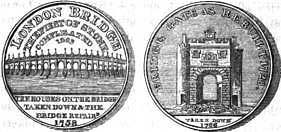
Two Bronzed or Copper Medalets:
LEFT: Obverse, a view of a Bridge, Legend "LONDON BRIDGE, THE FIRST OF STONE COMPLEATED 1209"
Legend on the Exergue "THE HOUSES ON THE BRIDGE TAKEN DOWN AND THE BRIDGE REPAIR'D 1758"
Reverse, a figure of Britannia with spear and shield, seated on a rock, holding an olive-branch;
Legend, indented on a raised circle round the field, "BRITISH PENNY TOKEN'
On the Exergue a cypher "P.K. Mdccxcvii" Legend on the edge, "I PROMISE TO PAY ON DEMAND THE BEARER ONE PENNY"
RIGHT: Obverse, an ancient gateway, Legend "BRIDGE GATE AS REBUILT 1728"
Legend on the Exergue, "TAKEN DOWN 1766."
1770: London Bridge, Thomas Gardner -

London Bridge, copper engraving, Thomas Gardner, 1770
1788: Old London Bridge Herbert Pugh -

before 1788 Herbert Pugh "London Bridge from The Old Swan" oil on canvas 98 x 123 cm Bank of England Museum, London
1794 J.M.W.Turner -

1794c J.M.W. Turner "Old London Bridge" graphite and watercolour on paper Tate, London
1795: London Bridge Picture -

London Bridge. June 1, 1795. Farington R.A. delt. J.C. Stadler sculpt.
(Published) by J. & J. Boydell, Shakespeare Gally. Pall Mall & (No. 90) Cheapside (London)
1799?: London Bridge Watercolour, painted 1829 -

South West View of London Bridge
Watercolour in 1829 showing old bridge perhaps c. 1799?
Gideon Yates
1799: London Bridge Picture -

London Bridge. May 29th 1799. From the S.W.
I have also a photo of a watercolour probably based on the above prints -

London Bridge 1799?
1799: Competition for designs to replace the old bridge was held, prompting the engineer Thomas Telford to propose a bridge with a single iron arch spanning 600 ft (180 m). It was not built. John Rennie’s design was accepted. The new bridge was built in 1822, 100 feet upstream of the original site at a cost of £2,000,000, and was completed by Rennie's son.
A Treatise on Bridge Architecture", by Thomas Pope in 1811: -
... yet London Bridge is still deemed so unfit for its situation, that it is intended to take it down, and to erect an elegant cast-iron bridge in its stead.
And here is Thomas Telford's design for the new bridge - he planned an elegant cast iron bridge - but it was rejected -

Thomas Telford's rejected London Bridge design
Life of Thomas Telford, Samuel Smiles -
The originality of the design was greatly admired, though there
were many who received with incredulity the proposal to bridge the
Thames by a single arch, and it was sarcastically said of Telford
that he might as well think of "setting the Thames on fire."
Before any outlay was incurred in building the bridge, the design
was submitted to the consideration of the most eminent scientific
and practical men of the day; after which evidence was taken at
great length before a Select Committee which sat on the subject.
Among those examined on the occasion were the venerable James Watt
of Birmingham, Mr. John Rennie, Professor Button of Woolwich,
Professors Playfair and Robison of Edinburgh, Mr. Jessop,
Mr.Southern, and Dr. Maskelyne. ...
It would appear that the Committee came to the general conclusion
that the construction of the proposed bridge was practicable and
safe; for the river was contracted to the requisite width, and the
preliminary works were actually begun.
Mr. Stephenson says the
design was eventually abandoned, owing more immediately to the
difficulty of constructing the approaches with such a head way,
which would have involved the formation of extensive inclined
planes from the adjoining streets, and thereby led to serious
inconvenience, and the depreciation of much valuable property on
both sides of the river.
Telford's noble design of his great
iron bridge over the Thames, together with his proposed embankment
of the river, being thus definitely abandoned, he fell back upon
his ordinary business as an architect and engineer, in the course
of which he designed and erected several stone bridges of
considerable magnitude and importance.
1792: Picturesque View on the Thames, Samuel Ireland -

London Bridge Samuel Ireland, 1792
WE now approach London bridge, a specimen of the Gothic labors[sic] of our ancestors,
and no less a subject of reproach to those
who have the superintendance of it in the
present day. This perilous absurdity, for
such in its present renovated, if not mutilated
state, it presents itself to a modern
eye, has in its day been styled the "wonder of the world", and properly enough may
now bear that epithet, it being a matter
of astonishment to every one, that it is yet in existence.
The enormous size of the sterlings, which
are and must be increasing, as the piers fall
into decay, will in all probability, in the
course of time, shut up the current through
the few arches that still remain in use.
These sterlings are by no means coeval with
the bridge, nor are they, as is vulgarly supposed, at all necessary either in aid of the
depth of water, or to restrain the current at
ebb, when the river is found navigable fo
many miles above the reach of the tide : the
water is now so dammed up by these incumbrances, that at the return of the tide, it
is near five feet higher above than below
the bridge, and in its fall has so many
tremendous cataracts, and hideous roarings,
as to fill the mind of the spectator with
horror.
WHEN the nuisance of the houses on the
upper part of this bridge was removed in
1756, it is matter of astonishment that the
whole of this disgraceful lumber was not taken
away. The expence which has been incurred,
on a moderate computation, within
the last century, would have defrayed twice
the charge of building an elegant structure,
and would probably have saved the lives of
perhaps thoufands of his majefty's best subjects, the industrious and laborious poor.
AMONG the many dreadful calamities that
have happened near this bridge, the premeditated
death of Mr. Temple, only son of Sir
William, of whom I have had occasion to
make mention in this work, is deserving notice.
On the 14th of April, 1689, he hired
a boat on the Thames, and directing his
waterman to London Bridge, (having previously filled his pocket with stones) there
plunged himself into the stream, and instantly sunk to rise no more. The apology
for this rash action was thus worded in a
note, found in the bottom of the boat.
"MY folly in undertaking what I could not perform, whereby some misfortunes "
have befallen the King's service, is the
cause of my putting myself to this sudden
end. I wish him success in all his undertakings, and a better servant."
The singular reflection of his father on this occasion, "
That a wise man might dispose of himself, and make his life as short as he pleased" —
breathed more the principles of stoicism, and
of the philosophy of Zeno, than of parental
affection, or the lessons of Chriftianity"
The width of the river is here nine hundred and fifteen feet, and the bridge consists
of nineteen irregular arches, each so unlike its
neighbour in size and shape, as to baffle any
attempt at criticism.
This bridge was constructed in 1176, by one Peter, Curate of
Colechurch in London, a person high in reputation for his architectural skill ; he died
four years before it was finished, which
was in 1209, a period of thirty-three
years; it was completed by three merchants
of London. The architect was interred
in a chapel erected at his own expence, on the east fide of this bridge. In the year 1758,
two years after the demolition of this and
other buildings, it was described as a beautiful
arched Gothic structure, sixty-five feet
long, twenty broad, and fourteen high, paved
with black and white marble, and in the
middle a sepulchral monument, wherein was
deposited the remains of Master Peter the
Curate. This chapel had an entrance from
the river by a winding staircase, and likewise
one from the street, and was therefore calculated
to receive the prayers of those who
travelled by water as well as by land.
1814: London Bridge -

London Bridge, S Owen, 1814. © 1999 Motco Enterprises Ltd
George Borrow Old London Bridge from Lavengro:
This fictional account written in 1851 refers
to the old bridge after the houses were removed – so between 1750 and 1825 -
A strange kind
of bridge it was; huge and massive, and seemingly of great antiquity.
It had an arched back, like that of a hog, a
high balustrade, and at either side, at intervals,
were stone bowers bulking over the river, but open on the other side, and furnished
with a semicircular bench. Though the
bridge was wide - very wide - it was all too narrow for the concourse upon
it. Thousands of human beings were
pouring over the bridge. But what
chiefly struck my attention was a double row of carts and wagons, the
generality drawn by horses as large as elephants, each row striving hard in a
different direction, and not unfrequently brought to a stand-still. Oh the cracking of whips, the shouts and
oaths of the carters, and the grating of wheels upon the enormous stones that
formed the pavement! In fact there was a wild hurly-burly upon the bridge which
nearly deafened me.
But, if upon
the bridge there was confusion, below it was a confusion ten times
confounded. The tide, which was fast ebbing, obstructed by the immense
piers of the old bridge, poured beneath the arches with a fall of several feet,
forming in the river below as many whirlpools as there were arches. Truly
tremendous was the roar of the descending waters, and
the bellow of the tremendous gulfs, which swallowed them for a time, and then
cast them forth, foaming and frothing from their horrid wombs.
Slowly
advancing along the bridge, I came to the highest point, and there I stood
still, close beside one of the stone bowers, in which, beside a fruit-stall,
sat an old woman, with a pan of charcoal at her feet, and a book in her hand,
in which she appeared to be reading intently.
There I stood,
just above the principal arch, looking through the balustrade at the scene that
presented itself - and such a scene!
Towards the Right bank of the river, a forest of masts, thick and close,
as far as the eye could reach; spacious wharfs, surmounted with gigantic
edifices; and, far away, Caesar's Castle, with its White Tower. To the right, another forest of masts, and a
maze of buildings, from which, here and there, shot up to the sky chimneys
taller than Cleopatra's Needle, vomiting forth huge wreaths of that black smoke
which forms the canopy - occasionally a gorgeous one - of the more than Babel city.
Stretching before me the troubled breast of the mighty river, and,
immediately below, the main whirlpool of the Thames
– the maelstrom of the bulwarks of the middle arch – a grisly pool, which, with
its superabundance of horror, fascinated me.
Who knows but I should have leapt into its
depths? - I have heard of such things - but for a rather startling occurrence
which broke the spell.
As I stood upon
the bridge, gazing into the jaws of the pool, a small boat shot suddenly
through the arch beneath my feet. There were three persons in it;
an oarsman in the middle, whilst a man and a woman
sat in the stern. I shall never forget the thrill of horror which went
through me at this sudden apparition. What! – a boat – a small boat –
passing beneath that arch into yonder roaring gulf!
Yes, yes, down through that awful water-way, with more than the swiftness of an
arrow, shot the boat, or skiff, right into the jaws of the pool. A
monstrous breaker curls over the prow – there is no hope;
the boat is swamped, and all drowned in that strangling vortex.
No! the boat, which appeared to have the buoyancy of a
feather, skipped over the threatening horror, and the next moment was out of
danger, the boatman – a true boatman of Cockaigne that – elevating one of his
sculls in sign of triumph….
Whether anyone
observed them save myself, or whether the feat was a common one, I know not;
but nobody appeared to take any notice of them.
1815: Louis Simond - a real account of shooting the bridge -
Nothing can well be uglier than London bridge ; every arch is of a size different from its next neighbour;
there are more solid than open parts; it is in fact like a thick wall, pierced with small unequal holes here and there,
through which the current, dammed up by this clumsy fabric, rushes with great velocity,
and in fact takes a leap, the difference between high and low water being upwards of 15 feet.
Passengers are generally landed above, and taken up below the bridge;
but being desirous of trying this little Niagara, which cannot be very dangerous,
since so many boats pass it every day in safety, and being quite sure of reaching the shore by swimming,
I remained with the boatman.
He took the third arch, placed his boat in a direct line, then rested on his oars.
The boat shot along an inclined plane, through the narrow hole, not 20 feet wide I believe, -ascended a little,
then descended an abrupt step, -the prow straight down, -and up again in a moment,
-lifting some water into the boat, which turned several times round in the eddy below the bridge,
before it got into the straight current.
I am astonished this fall, repeated twice a-day for some hours, has not undermined the bridge long ago.
1817 Daniel Turner -

before 1817: Daniel Turner, "The Thames at London Bridge" oil on canvas
55 x 100 cm Bank of England Museum, London
1821: Observations on the relative heights of the tide above and below London Bridge taken on the 29th July:
| 9.30am | Low water below bridge | Fall 5' 2" |
| 10.40am | Level | |
| noon | Rise 1' 6" | |
| 2.18pm | High water below bridge | Rise 7" |
| 2.35pm | High water above bridge | Rise 4" |
| 3.10pm | Level | |
| 6.00pm | Fall 3' 5" | |
| 10.27pm | Low water below bridge | Fall 5' 4" |
1824: Time's Telescope Or, A Complete Guide to the Almanack -
THE COMPLAINT OF OLD LONDON BRIDGE. A Vision.
Our sapient common-council men
Have passed a stern decree,
That London's ancient Gothic bridge
Shall shortly cease to be.
One eve, reflecting on this act,
I sought old Thames's marge !
The waning moon shone fitfully
On wherry, punt, and barge.
The antique bridge, but dimly seen
By Luna's pallid beam,
Seem'd like a baseless fabric wild
Of some fantastic dream.
I stood long musing on the scene,
Like one transfixed by spell ;
I thought, had but that bridge a tongue.
What wonders might it tell !
Scare had the thought occur'd to me,
When lo ! I seem'd to hear
A hollow voice borne on the wind,
Which murmur'd in my ear :
"Frail child of earth, attend to me",
It said, or seem'd to say ;
"I am the genius of yon bridge,
Which soon must pass away".
To thee I will unfold my mind,
For thou art not of those
Who wish my downfall, and have brought
My being near a close.
They're city cormorants, that feed,
Like chickens in a coop,
On ven'son, turkey, sav'ry chine,
And green fat turtle soup.
How different from the hardy race
That stretch'd me o'er the flood !
A truss of straw composed their beds,
Their pillows, logs of wood.
Few foreign dainties grac'd their board -
Roast beef was ever there ;
Plum-pudding too, and wassail strong,
In which to drown old care.
Their weak descendants o'er me pass,
Like spectres, pale and wan ;
How alter'd from the bold and free —
The ruddy Englishman !
I've stood five hundred years alone,
A holy monk's renown,
Adorn'd with towers and battlements,
Old Thames's mural crown.
But rivals have sprung up of late,
Which flout me to my face,
And I, though rear'd of old, to them,
Pardie, must now give place.
Seest thou yon unsubstantial thing [ie Southwark Bridge]
Through which the moon doth gleam,
'Tis like a mighty skeleton
Stretch'd o'er the river's stream.
This morn I heard a dreadful sound
Loud thundering in my ears,
Of sinking piles, whereon to found
My future rival's piers.
What revolutions have I seen
Since first my head was rear'd !
What generations of mankind
From earth have disappear'd
Your Edwards and your Henrys too
I've seen with kingly pride,
Begirt with mail-clad barons fierce,
In triumph o'er me ride.
Eliza of the 'lion port'
My fancy still recalls ;
Full oft she crost me, with her court,
To seek fair Greenwich halls.
And I have tuneful Chaucer seen,
And all his pilgrim throng,
Who rode with him to Becket's shrine —
They still live in his song.
When rival roses shook this isle,
My battlements oft bore
The sever'd head and mangled limb,
On spikes besmeared with gore.
And I have seen beneath me glide,
At midnight's awful hour,
With muffled oars, the traitor barge
Bound for yon bloody Tower.
I've witness'd monarchy once quell'd
By the republic's sword ;
This in its turn I saw expell'd,
And monarchy restored.
When the red scourge o'er London raged
Of all-consuming fire,
I heard the crash of house, and tower,
And battlement, and spire.
I've seen grim death triumphant reign,
I've heard the shrieks of woe,
When Pestilence stalk'd through the streets,
And laid her thousands low.
But, soft! I scent the morning air :
Let what I've said be penn'd ;
More might I add, but time would fail,
So here shall be an end."
As ceased these sounds, from Paul's high fane
The mighty deep-toned bell
Pealed on the drowsy ear of night
The past day's parting knell.
1825: The Prose equivalent from The Chronicles of Old London Bridge by an Antiquary -
So numerous are the alterations and modernisms in almost every street of this huge metropolis,
that I verily believe, the conservators of our goodly city are trying the strength of a London Antiquary's heart;
and, by their continual spoliations, endeavouring to ascertain whether it be really made "of penetrable stuff".
For my own part, if they continue thus improving, I must even give up the ghost;
since, in a little time, there will not be a spot left, where any feature of age will carry back my remembrance to its ancient original.
What with pullings-down, and buildings-up; the turning of land into canals, and covering over old water-ways with new paved streets;
erecting pert plaister fronts to some venerable old edifices, and utterly abolishing others from off the face of the earth;
London but too truly resembles the celebrated keepsake-knife of the sailor, which, for its better preservation, had been twice re-bladed,
and was once treated with a new handle.
