Lock is between old and new weirs Tel: 01367 52434 drop: 5' 7" length: 109' width: 14'

BUSCOT LOCK
There are now three islands here:
(Buscot New Weir Island)
Right bank in the lock, the island created by cutting the new weir.
Buscot lock island
Left bank in the lock
Brandy Island
left bank just above Buscot Lock
Buscot Church
on the left bank above Brandy Island
Buscot Cheese Wharf
left bank 500m above church. Fred Thacker's map shows "Old Store Houses"
1087: Buscot in The Domesday Book
Earl Hugh holds BUSCOT, and Robert [holds] of him.
Earl Harold held it. It was then assessed at 40 hides: now at 6 hides.
There is land for 20 ploughs. In demesne are 4 ploughs and 25 villans and 25 bordars with 8 ploughs.
There are 6 slaves and a fishery rendering 18s 8d, and 300 acres of meadow.
Of this land Drogo holds 8 hides and Ranulph 4 hides; and there are in demesne 2 ploughs;
and 2 villans and 6 bordars.
The whole, in the time of King Edward, was worth £20; and afterwards £17; now £26.
1909: This section in The Stripling Thames by Fred Thacker
1910:
Thames Valley Villages, by Charles G Harper
As Buscot Lock is approached from downstream the
banks are very much higher than we have seen up to now, more like the banks
five miles upstream well above the limit of navigation, where the stream is
more natural, that is above the effect of the weirs.
It is of course immediately below a weir that
you are most likely to see the river as it once looked before it was altered
for navigation and milling purposes.
(Close above a weir the banks will be almost level with the water if the
weir as been built to the maximum height possible in that place.
Presumably in times of flood there will be
much less rise just above a weir than in other places.)
Meanders herald the coming lock.
Site of a Bridge at the tail of the Lock (presumably for the light railway on Buscot Farm -see below).
The Lock has a new weir cut through the
field on the Right bank. The old weir is
on the Left bank. Be careful of the
current here. The Lock has a National
Trust Picnic Site, and you will occasionally find yourself being gawped
at by parties of children.
What a privilege for you, to be an object lesson in how a lock works -
just try not to fall in (for the sake of the children)
1690: Baskerville -
And in Buscot I understand
Dwells a Captain of our trainbands
Master Loveden is his name
A person of good worth and fame
Long may he live in wealth and honour
With a kind lass to tumble on her.
Now there's a rhyme with 'honour' which would not occur to your average poet! Master Loveden has long ceased to take advantage of kind lasses and is buried in Buscot Churchyard.
1780: The mansion and park at Buscot built. (Now National Trust).
1787: Edward Loveden Loveden inherited Buscot Park. He was a magistrate, High Sheriff of Berkshire, independent MP, co-founder of the Royal Agricultural Society and chairman of the Parliamentary committee which in 1793 oversaw the improvement of the Thames.
1790: The lock was built at the same time as St John's Lock.
Fred Thacker, The Thames Highway, Volume II, Locks and Weirs -
This poundlock, built in stone by J. Nock, the builder of St John's, was opened at the end of 1790, with a toll of 2½d. per ton.
It is often alluded to as New Lock: a label found convenient for new stations.
In 1791 Mr E. Loveden owned the weir: a champion of Thames Navigation.
His name is constantly occurring in the navigation history of the Thames at this time;
and as a picture of the man, and a most admirable example of the retort courteous, I present a letter of his from the City records
in answer to a none too pleasant criticism by the Corporation of his fellow Commissioners' procedure.
1796: Buscot Park, Boydell's "History of the Thames" -

Buscot Park.
June 1, 1793. J. Farington R.A. delt. J.C. Stadler sculpt.
(Published) by J. & J. Boydell, Shakespeare Gally.
Pall Mall & (No. 90) Cheapside (London).
Buscot Cheese Wharf, left bank. Where the river comes close to the main road.
1813: 'General view of the agriculture of Berkshire, by William Fordyce Major -
From the wharf at Buscot, belonging to Mr. Loveden, on which warehouses are built for the reception of cheese, and rented by the cheese-mongers in London, not less than between two and three thousand tons of cheese are annually sent down the Thames
1816: Fred Thacker, The Thames Highway, Volume II, Locks and Weirs -
Buscot Park, 2nd Nov., 1816
Sir,
Having been much from home lately I must plead absence as an excuse for not having sooner acknowledged your kind Communication,
and request you will, tho' late, offer my thanks to the Thames Navigation Committee for the Copy of their Report.
The bends in this Upper District certainly impede the Navigation, but help to keep up the Water, which if those were cut would run off too rapidly,
and occassion a necessity for more Pound Locks.
The Government of the Commissioners is badly formed, a new Constitution is wanted.
What is intended to be done by the New Act to be applied for in the next session?
I have frequently thought of going in the shallop from hence by T & S Canal to the Severn, Bristol and back thro' the K and A to Reading
and up the Thames to this place. [ The city had just performed this tour. ]
Will you favour me with the Stations you took each Night and accommodation you met at them?
The North Wilts is a bad Prospect, and proceeds very slowly.
I hope your Committee will make frequent surveys and not pass without calling on
Sir
Your obliged humble Servant
E.L.Loveden.
A hare and pheasant will be sent by this Nights Coach for your acceptance.
1818: Letter from Mr Loveden to Sir John Sinclair, Bart.
... There is a general complaint among the dairymen that they cannot sell their cheese.
The country factors are in a conspiracy together, and will not give more than 36s. per cwt.
for that called in London single Gloucester;
and yet I observe, in the Farmer's Journal, the price of such stated at 56s. to 66s.
Pray thank your son for his kind letter to me, and present my daughter's acknowledgments for his frank
attention.
Every thing very dull in the country. No money to be had; but we continue to keep the poor at work.
I hope your granddaughter and her mother are doing well.
I am ever, Dear Sir John,
truly yours,
E. L. LOVEDEN.
Keeping the poor at work sounds a bit vicious - but on balance I think he meant it well - he meant that he continued to provide employment so that the poor could be housed and fed. (I hope)
1822: Edward Loveden's Obituary in the Country Gentleman -
... almost every public undertaking was indebted to his purse or his judgment, and frequently to both.
He was a principal promoter of the junction of the Thames and Severn;
and the Thames Navigation was indebted to him for almost every real improvement in the upper districts, which has been made within a period of fifty years.
So much was he attached to the prince of British streams, on whose banks a large portion of his estate lay,
that he used to be called, jocularly by his friends,
"Old Father Thames,"
an application which he did not dislike on suitable occasions.
1834: Tombleson -
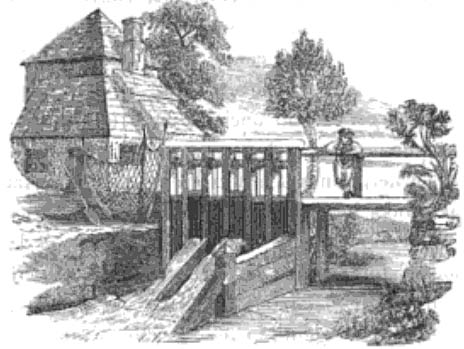
Buscot, Tombleson 1834
1859: Edward Loveden's family sold the estate to Robert Tertius Campbell newly returned from Australia. He bought the villages of Buscot and Easton Hastings with their total population of some 3500. And he set about turning this run down estate into a marvel of modern Victorian Industry.
1859: The Thames, Mr & Mrs Hall
passing the village of Buscot, where is found the first example of the lock and weir in combination. Buscot has a very plain old church, with no other feature to notice but a Norman chancel arch. The vicarage is a large mansion of the time of William III., and the garden has cut trees and fir bowers in the semi-Dutch taste of that era
1870s: The factory on the Left bank above Buscot Lock -
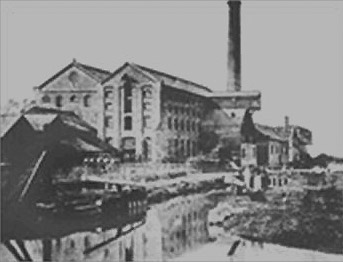
Campbell's Buscot Factory.
Campbell decided to produce alcohol from sugar
beet, so first
he thoroughly drained the land, then he built a twenty acre reservoir, then
three large water wheel driven pumps to fill it, one at Buscot
and two at Eaton (see above).
With the land now properly irrigated Campbell grew his beet and collected it with a light railway with three locomotives, taking it to his distillery on the Left bank just above Buscot Lock. He also manufactured oil cake, gas, fertilizer and vitriol. At one point his alcohol was sold to France at 2/6d a gallon!
1879: The entire enterprise was scrapped because it no longer made a profit - and now we are left with a few otherwise puzzling remains. There is still a pump on the Left bank above Buscot Lock which supplies water to the reservoir and this is on what was known as Brandy Island.
1876: Map showing Buscot Industrialisation: the "Cake" Factory (oil), Berkshire Distillery, Gas works (private), the Manure Works (artificial)
and the Vitriol (sulphuric acid) Works.
[ This was all removed - or being removed by 1883 ] -
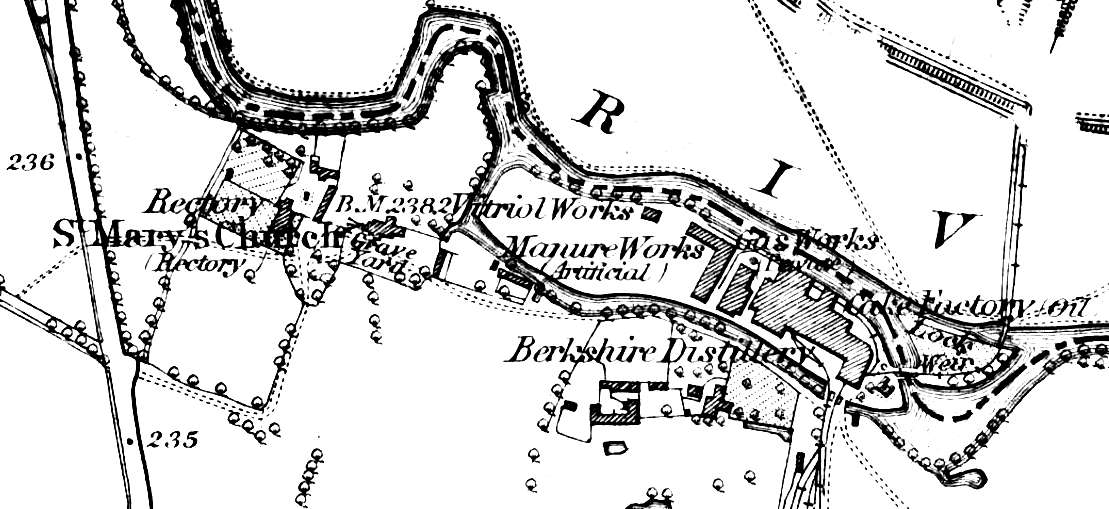
1876 Map of Buscot
1876: Map showing Buscot Railways: from North of the lock over a bridge across the tail of the lock to the factories and then to a marshalling yard, and then by two lines around the whole estate, the northern line branching immediately to the cattle sheds and continuing on to Buscot Wharf on the canal cut from the river and terminating at the road, the southern going around the western and southern edges of the estate terminating at Oldfield Farm which perhaps had an engine house. There were three locomotives -

1876 Map of Buscot Railways
1883: Buscot Church from River, Henry Taunt -

Buscot Church from River, Henry Taunt, 1883
© Oxfordshire County Council Photographic Archive; HT3776
1885: And how completely the industrial works were scrapped is shown by this from The Royal River only six years later -
... rare old Buscot. The days of its weather stained lock and weir are numbered ...
but so long as they remain they will be, in conjunction, an object such as the artist loves,
and a reminder to us all of other days when the world was not so jaded as now,
when things were not so new, and when the ways of men were more primitive.
There is a very fine tumbling bay on the farther side of the weir,
and a sharp sweep of swiftly running water coursing over a gravelly shallow,
upon which the trout come out to feed at eventide,
and the silvery dace and bleak poise in happy security during the long summer days.
One is tempted naturally to land at the little village. The square, countryfied-looking church tower,
surrounded by old trees, and approached through a flower garden,
suggests, as your boat pauses at the lock, that it will be better to spend a quarter of an hour
afoot than in the tedious process of passing through.
1887: Edward Tertius Campbell died, bankrupt. Actually there was more to it than that:
A scandal concerning his elder daughter, Florence, caused his downfall, bringing him in sorrow to the grave he now occupies at Eaton Hastings churchyard. She was married to lawyer Charles Bravo, son of John Ricardo MP, in 1875. The following year Bravo died of antimony poisoning and, after two inquests, a verdict of wilful murder was returned. However, no one was ever charged. The murder held Britain spellbound for years — and Florence was a major suspect; particularly as it was revealed that before her marriage she had had an affair with married society doctor James Gully, who had founded his ‘hydrotherapy’ clinic at Malvern that had been largely responsible for that town’s growing prosperity. Two years after the murder, by then a social outcast, Florence died of alcohol poisoning aged 33 and was buried by night by the porch at Buscot Church. Her father’s business affairs then went into a decline.
>1922: Roundabout the Upper Thames by Alfred Williams
The village of Buscot, though insignificant in size, is famed throughout the Upper Thames Valley.
This, in the first place, is owing to the beauty of its surroundings, its woods and grounds, and, secondly, by reason of the remarkable energy and prodigality of a former occupant of the mansion in the park, whose name became familiar for many miles around.
The doings of Squire Campbell, of Buscot Park, were told far and near, and many people came to the little riverside village in order to obtain employment at one or other of the great works he took in hand.
He brought into cultivation hundreds of acres of land that before had been useless, dug lakes and reservoirs at the cost of many thousands of pounds, and turned what had been a wilderness into a beautiful and fertile paradise.
Honey flowed like water, and the workmen were as the squire swore he would have them to be, i.e. "as thick as flies"; there was no limit to the outpouring of gold till the Crimean War arose and ruined the well intentioned but imprudent speculator.
Formerly Buscot had its medical practitioner, who did something for suffering humanity, as is proved by his records unwittingly left behind, in which we read the frequently occurring and significant phrase:
"For bleeding old Betty Martin, one shilling".
With the doctor's records is preserved a leather label formerly nailed to a package consigned to the Vicar from London, and which is reminiscent of other days:
To ...
Burscot Parsonage,
Near Leachlade,
Gloucestershire.
By Waggon to Oxford. To be forwarded by Caravan No.1
The road through the village is one of the chief highways from Gloucester to London and was regularly traversed by the heavy lumbering waggons and stage coaches before the railways were made.
The grey silent church stands but a few paces from the river's brink, upon a small terrace sufficiently high to prevent its being flooded after the heavy winter rains.
The building dates from the twelfth century, though no part of the original survives, with the exception of the trans-Norman chancel arch, resting upon its clustered pillars, and this was altered to a pointed shape and spoiled about the year ll80.
The interior is simple.
The walls and roof are cemented over and there is little of interest besides the east window — painted by Burne-Jones during his sojourn with the poet Morris at Kelmscott — the old Spanish lectern, and an oak pulpit, with three panels painted by the Flemish artist, Mabuse.
The centre panel, representing the Adoration of the Magi, is remarkable in that the black king is painted with white legs.
[In 1922 Alfred Williams mentioned the racist legend that the black king's knees had to be made white before he could adore the Saviour. Sorry!]Joh
Today the church is strewn with cuttings of
flowers and leaves and is generally untidy, for it is being decorated for Harvest Festival.
All the morning the farmers' wives have been employed arranging fruits, flowers, and vegetables in the windows and twining the golden corn around the pulpit and choir stalls.
In the corner is a sheaf of wheat with heavy ears; here the pure white or bronze chrysanthemums mingle with the modest Michaelmas daisies, or the great gold-faced sunflower smiles broadly upon the richly coloured dahlias.
Village maidens pass noiselessly to and fro, disposing the bright-tinted leaves and inter-setting the blossoms and fruits, while others arrive with offerings of various kinds — oats and barley from the field, and the largest apples and vegetables from the garden.
The vegetables are piled upon the floor, while the orchard fruits are set in the windows; a large home-made loaf is fixed conspicuously upon the lectern.
One thing alone is wanting to the picture, that is, a large shock or stook of a dozen or twenty sheaves set up in the middle of the church or a heap of threshed grain, such as the Greek poet Theocritus tells us they had at their harvest festival held in honour of Ceres, with the great winnowing shovel thrust down into it, while the goddess, crowned with garlands and holding handfuls of wheat and poppies, looked benignly down upon them at the celebrations.
A water wheel, twelve feet high and sixteen feet wide, stands on the river.
The weight of this is over twenty-five tons, and it has a driving capacity equivalent to twenty-one horse-power.
It is fitted with a number of iron shell-like blades; the water, flowing swiftly down a chute beneath a heavy cast-iron plate, rushes upon these and forces them round, enabling the wheel to revolve four or five times a minute.
Alongside is a shed containing powerful pumps which are operated by means of a system of cogs and gear.
The teeth of the cogs around the grent wheel are worn as thin as pennies, for they have been in constant use for twenty years.
A special Act of Parliament was needed to sanction the building of the wheel on the Thames; upon its continued exertions depends the success and welfare of all the farms on the estate, which would be deprived of water if the pumps were stopped.
A spirit factory stood on the bank of the river above the lock-gate.
This was the largest and most expensive of all the experimental works undertaken by the squire, but though it cost a hundred thousand pounds to build and equip, and was superintended by French experts, it was doomed to failure after ten years' working.
The villagers who worked at the distillery say that excessive duties killed the industry; whatever the cause of its demise there was no lack of energy on the part of the squire to make the concern profitable.
Nevertheless, in spite of his failures, the squire was a remarkable man.
Whatever he attempted was on a grand scale, and if one scheme failed he immediately embraced another and was undaunted by difficulties, however great they might have been.
The men on his estate worked nine hours a day and received fair wages.
He staggered all the other farmers and landowners in the neighbourhood by reason of his profuseness, his unheard-of experiments, and his tremendous energies.
Beet was the material from which the spirit was extracted.
A system of artificial irrigation was contrived to fertilise the hill ground; the water was pumped up from the river by the wheel.
The squire manufactured his own manures for growing the beet, grinding up immense quantities of coprolite.
Besides this he had quarries opened and limekilns built to produce lime for dressing the land.
The hauling was done by steampower.
The whole countryside throbbed with life, and the earth quivered beneath the iron wheels of the heavy traction engines.
To cultivate his land he had several sets of steam ploughing tackle of considerable dimensions.
The engines were of thirty horse-power each, and each weighed thirty tons, that is, more than double the weight and three times the power of those ordinarily in use to-day [1922].
They ploughed night and day throughout the autumn and winter, until the whole of the land had been well broken up and cleaned ready to take the seed in the following spring.
To enable the steam-ploughing to proceed by night a system of limelight was installed on the plant.
If the ground was very wet the engines moved on timbers.
The squire visited the field at all hours of the night, and provided rehef gangs; he could brook no delays in getting forward with the work of cultivation.
The squire's wife was as energetic as her husband.
She was often to be seen striding through the fields with the tail of her skirt drawn through her knees and buckled to her waistband in front.
The first method of steam-ploughing differed from
that followed in our own time, or even in Squire Campbell's early days.
Then only one engine mas employed.
This was a portable machine, and was drawn out to the field by horses.
If thc field was of a moderate size the engines stood on one side, but if
it was very large it was set in the middle.
Near the engine was a heavy double windlass, with which the cables were wound, and which was driven by means of a belt from the engine.
Situated at several points about the field were "porters", containing small pulley wheels through which the cables ran.
These were attached to a large iron anchor which dug deeply into the earth as the engine was pulling from the windlass.
When the plough reached the end of the field the cable was switched off on to another pulley and the implement went plunging back across the piece.
The anchor was released from the earth and shifted with levers; several assistants, besides the engineman and steersman, were required to look after the tackle.
When the traction engine first made its appearance on the road it was provided with a set of shafts fixed in front and a horse, as it were, to draw the machine.
This, curious as it may seem, was compulsory, in order not to frighten the horses attached to other vehicles on the highway.

Buscot Water Wheel seen in 1888
Singing Water, R C Lehmann
Listen to 'Singing Water'
I heard - 'twas on a morning, but when it was and where,
Except that well I heard it, I neither know nor care -
I heard, and, oh, the sunlight was shining in the blue,
A little water singing as little waters do.
At Lechlade and at Buscot, where Summer days are long,
The tiny rills and ripples they tremble into song;
And where the silver Windrush brings down her liquid gems,
There's music in the wavelets she tosses to the Thames.
The eddies have an air too, and brave it is and blithe;
I think I may have heard it that day at Bablockhythe;
And where the Eynsham weir-fall breaks out in rainbow spray
The Evenlode comes singing to join the pretty play.
But where I heard that music I cannot rightly tell;
I only know I heard it, and that I know full well:
I heard a little water, and, oh, the sky was blue,
A little water singing as little waters do.

Fred Thacker's map, 1920.
1930s?: Buscot Lock, Packer Collection -

Buscot Lock, Packer Collection, 1930s?
© Oxfordshire County Council Photographic Archive; D240103a
1951: Edward Ardizzone, Sketches from a Holiday Afloat -
Leave Lechlade in the afternoon. The weather lovely, the river winding among flat
fields, its banks high and covered with flowers.
Successfully negotiate our first two locks and moor for the night at an island by a weir.
It rains before dark. Three in a boat too many. The mattress hard and I long for morning.
Buscot Old Parsonage - National Trust
Website
Buscot Rectory (Queen Anne), Left bank.
1992: Walter Askin -
I had seen an article in the Saturday Review of Literature about a house that was available
for professors in literature and fine arts. The fellow who had owned this house was Peter Stuckley,
and he was a fan of things American, and, as a matter of fact, lived with another American chap.
He painted his house there in colors that he got from Williamsburg.
He was true establishment - Eaton, Cambridge, Grenadier Guards, Lloyds of London, heart attack,
retired to the country. And so he had this old parsonage in the little town of Buscot,
only seventeen people, located near Farrington, about twenty-five miles west of Oxford
on the road going out to Cheltenham and Lechlade.
They were looking for somebody to take
the house for five to twenty-two years, but no academic could do that. So I offered to
take care of the house for a year, to live in the house for a year. But I'd also need to
have the amount of rent reduced in it, and they did that for me, because they really needed
somebody sitting there, because this house came with a cook, a gardener, and the person
who came in and polished the brass, cleaned off the glass on the Hogarth prints and all of that.
So it was the most propitious situation you can imagine, this beautiful old house right on
the quiet upper reaches of the Thames between the last two locks.
You could see Buscot lock
and the St. John's lock, which sets the tone for the tide for the run of the entire river
of the Thames. And it came with a formal garden, a kitchen garden, a sheep pasture, a tithe barn,
an apple orchard, and so forth. And it was absolutely a delight.
None of us had had any servants. We always did for ourselves. And, of course, it was a
problem adjusting to having those people around, because they were like little children.
You had to take care of them and you had to take care of the internecine squabbles that
developed between them.
National Trust Buscot Old Parsonage Access Statement:
Buscot Old Parsonage, Nr. Buscot, Oxfordshire, SN7 8DQ.
T: 01793 762209
E: buscot@nationaltrust.org.uk
Introduction
1. This 18th-century house has a small walled garden, and is situated on the banks of
the River Thames.
2. Buscot Old Parsonage is a tenanted property. Visits can only be made via prior
arrangement to the tenant by emailing buscot@nationaltrust.org.uk Access is
accompanied by the tenant and only into one room of the property and part of the
garden
3. Not suitable for groups.
4. There is no toilet at this property.
5. Assistance dogs only are welcome
Arrival & Parking Facilities
1. There are 6 spaces in the church car park next door. It is a gravel car park and driveway
WCs: There are no toilets for visitors on site.
Contact details for more information
T: 01793 762209
E: buscot@nationaltrust.org.uk
October 2019

Buscot Lock,2000.