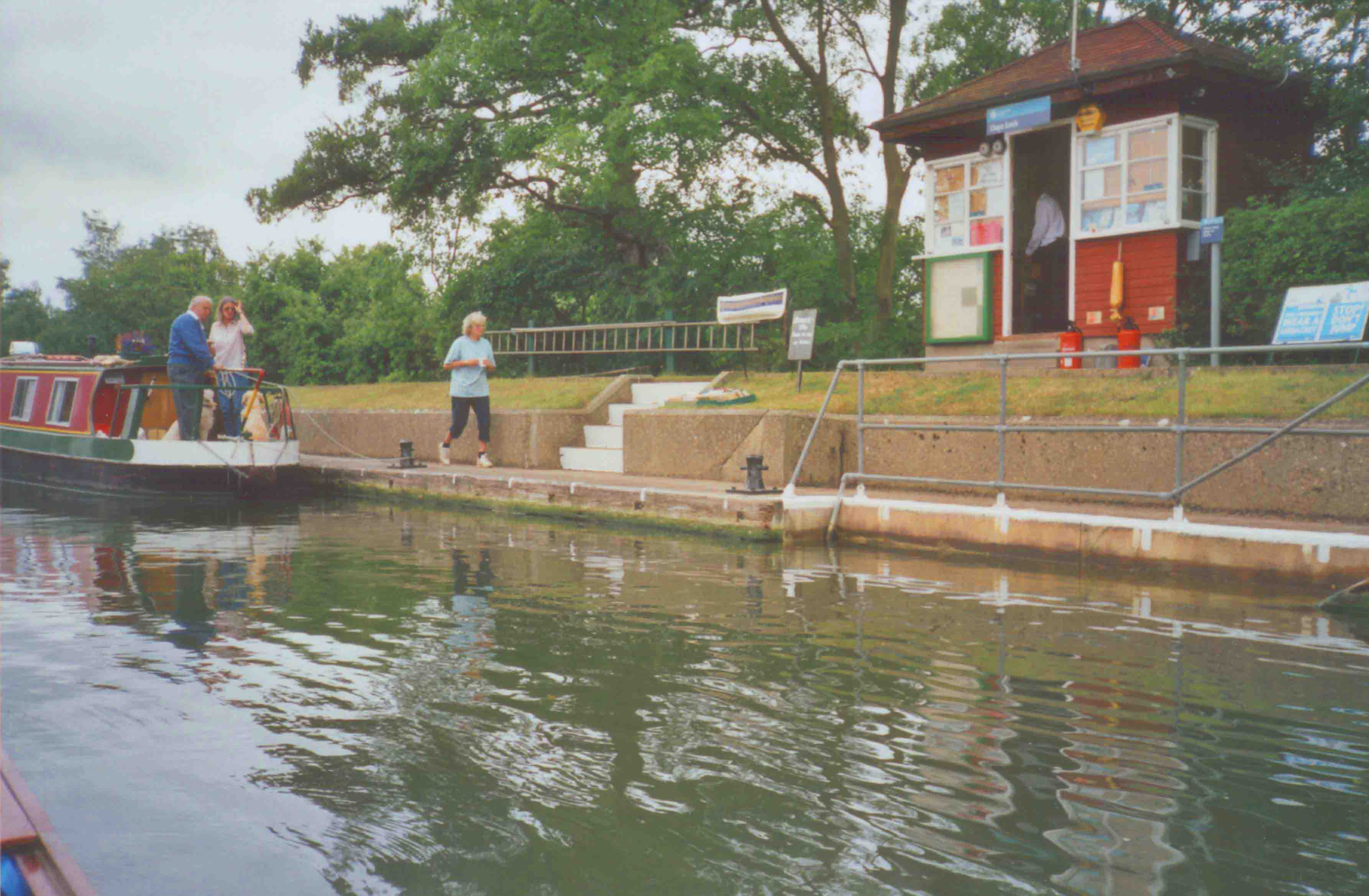
DAYS LOCK

River level loading ...


Flow data. Mean flow 28.1 cumecs; high flow exceeded 10% of the time 68.3 cumecs; low flow exceeded 95% of the time 3.3 cumecs

Day's to Clifton, Day's to Benson, Environment Agency 'Out and About' Guides

Maps

Left bank, length: 154', width 21'2"
 
CAMPING:   Days Lock, Little Wittenham, Oxon, OX14 4RD. 01865 407768. Pitches  on lock island, Good Friday to 31st September.  WC, showers, shaver points. Walkers, Cyclists and boaters only.  No car parking.

Map: Days Footbridge (Little Wittenham Bridge)

Below the lock and weir an island with a two part footbridge across it. Navigate left bank side. (ie keep right going upstream)
 
1837: Bronze British Buckler found in weir pool -

British Buckler found 1837

I now have the pleasure of submitting the drawing of a little round Buckler, recently added to the collection of Antiquities in the British Museum ...

This Buckler is of bronze or metal, measuring in diameter fourteen inches by thirteen. It is ornamented with two series of round bosses, between raised concentric circles, having a large boss or umbo in the centre. All the bosses are punched in the metal excepting four, two of which form the rivets to the handle within, and two are the rivets to the metal extremities apparently of a strap, these four bosses being consequently moveable.

This interesting object was found in the month of October 1836, on the lower margin of the pool of the Little Wittenham or Day's lock upon the river Isis, about half a mile above the junction of that river with the Thame stream, midway between Little Wittenham bridge and the weir connected with the lock, about one mile to the westward of Dorchester, in Oxfordshire, a hundred and fifty or two hundred yards from the western end of an earthwork, called Dyke hills, and three quarters of a mile from the intrenchment upon Sinodun or Little Wittenham hill.

Before 1870: A timber swingbridge with a navigation opening of about 18 feet.
 
1868:  Sedgefield photograph of this timber bridge.
 
1870:  Iron bridge built
 
1880: Bridge at Little Wittenham, Henry Taunt -

Bridge at Little Wittenham, Henry Taunt, 1880
© Oxfordshire County Council Photographic Archive;

1983-:  The Pooh Sticks Championships (for the RNLI Royal National lifeboat Institute) is held annually in March
 
1999:–

Days Footbridge 1999
Day's Footbridge, in 1999.

1530:  Leland – Dorchester Ferry “at high watars over the Tames”
 
1580-5:  a flashlock and weir in Dorchester (maybe this means on the Thame?)
 
1580-5: a weir at Little Wittenham kept by William Dunshe. Robert Gibbings gives an alternative name for Wittenham Clumps as “Mother Dunch’s Buttocks”  Perhaps lock keeper William’s wife had some memorable feature or other which gave rise to this?  One imagines that the bargemen might have perpetuated her memory …  Elsewhere I have seen it explained that it was the wife of the Lord of the Manor whose attributes were thus remembered.
 
1580-5: a weir at Long Wittenham belonging to Wyddowe Sawyer.
 
1788:  Days poundlock was built.
 
1802:  Mylne – refers to the Lock as Dorchester Lock –

In the cut below the lock there were three Thames & Severn barge-boats aground for want of water to get into it.  Caused by a flash at Benson below.

[ i.e. The weir at Benson had been opened causing the water level to drop downstream of Days. ]
 
1865:  Conservancy Report –

Days Lock in utter ruin:  how it holds together I do not know.  One of the gates is chained up;  the weir is also out of repair, and in a very dangerous condition indeed;  any flood breaking down one of these upper places may destroy the whole navigation.

1871:  Lock rebuilt.
 
1873: Taunt's Map and Guide to the Thames -

The view of the river at Day's Lock, in combination with the hills in the background, forms one of those characteristic "bits" of river scenery that our landscape painters love.
The view from the hill is very fine, and the remains of the earthwork fortification round the second hill (consisting of a perfect ditch, &c.), said to be Roman, are interesting.

1885: Days Lock rebuilding, Henry Taunt -

Days Lock rebuilding, Henry Taunt, 1885
© Oxfordshire County Council Photographic Archive; HT3907

2005:  Doug Myers, Little Wittenham Bridge, from the top of Harp Hill -

Little Wittenham Bridge, Doug Myers © 2005

Northmoor Trust

1885:  The Royal River -

Sinodun Hill and Day’s Lock, The Royal River, 1885
Sinodun Hill and Day’s Lock, The Royal River, 1885.

1904: Days Lock, Dredge -

Days Lock, Dredge, 1904
© Oxfordshire County Council Photographic Archive; D250357a

1906:  Days Lock, Mortimer Mempes –

Days Lock, Mortimer Menpes, 1906
Days Lock, Mortimer Menpes, 1906.

1923:  Days Lock house built.
 
1925:  Days Lock rebuilt.
 
1999:–

Days Lock, 1999
Days Lock, 1999.

Map: Wittenham Clumps

The hill on the right bank, visible for miles, is Wittenham Clumps (Robert Gibbings gives the alternative names “Maidens Breasts” and also “Mother Dunch’s Buttocks”). 
 
NORTHMOOR TRUST manages Wittenham Clumps.
Archaeology

6000BC: There is a wealth of evidence for occupation and activity on the hilltop from 6000 BC to the medieval period. The earliest evidence for occupation was provided by a scatter of flints left by Mesolithic hunter-gatherers
 
4000BC: flint tools, including an arrowhead, show that Neolithic farmers also visited the site between 4000 and 3000 BC.
 
1000BC: A previously unknown hilltop enclosure ditch, identified by English Heritage geophysical survey in 2002, was investigated in several trenches and was firmly dated to the Late Bronze Age (around 1000 BC).
 
The substantial defences of the Iron Age hillfort that replaced it were investigated for the first time, and contemporary pits and burials in the interior yielded a wealth of information about the lives of the Iron Age inhabitants.
 
The excavations also revealed copious and unexpected evidence for late Roman settlement and burial on the hilltop, and also medieval pits suggesting possible occupation in the 12th/13th century AD.
 
1772: Revd JOHN WHITAKER to Dr. DUCAREL

Manchester, June 13, 1772
MY WORTHY FRIEND,
Another great object was, to see the two famous hills near Dorchester, commonly called Mother Dunch's Buttocks, and the celebrated Dyke-hills.

And here I was remarkably happy in finding my notions of both so coincident with the nature of both, and both so finely taking the place which I had assigned them. In the 'History of the Roman Conquests', Dr. Stukeley has made the Dyke-hills into a British race-ground ; but the very site of them directly refutes the supposition, and they are evidently military entrenchments.

Here, at Dorchester, I met with a very surprising person in the clerk of the parish, a man that, in the low occupation of a joiner, shews a wonderful genius for Antiquities, pointed out to me many curious notices relating to this Roman town, and has even collected six or seven hundred Roman coins. Amongst these he has two or three that are certainly British, and one or two more that are conjecturally so ; and he shewed me a small Roman curiosity, in copper, which he called an ink-horn, but which I found to be a lamp.

1844: Joseph Tubbs of Warborough near Dorchester carved the following poem on the Poem Tree.  He left his notes on it to his nephew, who died at the age of 100 in 1949 and left the notes to Reading Reference Library.
 
1965: Dr Henry Osmaston took a tracing of the poem.
 
1995: a plaque reproducing the Osmaston tracing, located close to the (now dead) tree, was unveiled to commemorate the 150th anniversary of the poem.
 
I have adopted his best line as my title “Where Thames Smooth Waters Glide” -

As up the hill with labr'ing steps we tread
Where the twin Clumps their sheltering branches spread
The summit gain'd, at ease reclining lay
and all around the wide spread scene survey
Point out each object and instructive tell
The various changes that the land befel.
Where the low bank the country wide surrounds
That ancient earthwork form'd old Murcia's bounds.
In misty distance see the barrow heave,
There lies forgotten lonely Culchelm's grave.
Around this hill the ruthless Danes intrenched,
and these fair plains with gory slaughter drench'd,
While at our feet where stands that stately tower
In days gone by, uprose the Roman power
And yonder, there where Thames smooth waters glide
In later days appeared monastic pride.
Within that field where lies the grazing herd
Huge walls were found, some coffins disinter'd
Such is the course of time, the wreck which fate
And awful doom award the earthly great.

William Morris -

In this sweet field high raised above the Thames
Beneath the trenched hill of Sinodun
Amidst sweet dreams of disembodied names
Abide the setting of the August sun,
Here where this long ridge tells of days now done;
This moveless wave wherewith the meadow heaves
Beneath its clover and its barley-sheaves.

Across the gap made by our English hinds
Amidst the Roman's handiwork, behold
Far off the long-roofed church the shepherd binds
The withy round the hurdles of his fold
Down the foss the riverbed of old,
That through the long lapse of time has grown to be
The little grassy valley that you see.

Rest here awhile, not yet the eve is still,
The bees are wandering yet, and you may hear,
The barley mowers on the trenched hill,
The sheep-bells, and restless changing weir
All little sounds made musical and clear
Beneath the sky that burning August gives,
While yet the thought of glorious Summer lives.

Vanishing Britain, P H Ditchfield -

Every one who journeys from London to Oxford by the Great Western Railway knows the appearance of the famous Wittenham Clumps, a few miles from historic Wallingford. If you ascend the hill you will find it a paradise for antiquaries. The camp itself occupies a commanding position overlooking the valley of the Thames, and has doubtless witnessed many tribal fights, and the great contest between the Celts and the Roman invaders. In the plain beneath is another remarkable earthwork. It was defended on three sides by the Thames, and a strong double rampart had been made across the cord of the bow formed by the river. There was also a trench which in case of danger could have been filled with water. But the spoiler has been at work here. In 1870 a farmer employed his men during a hard winter in digging down the west side of the rampart and flinging the earth into the fosse. The farmer intended to perform a charitable act, and charity is said to cover a multitude of sins; but his action was disastrous to antiquaries and has almost destroyed a valuable prehistoric monument.


(Upstream to Burcot below Clifton Hampden)


Introduction
Estuary
PLA
QEII Br
Barrier
Tower Br
Custom Ho
London Br
; Frost Fairs
Cannon St Rb
The Great Stink
Southwark Br
Millenium Br
Blackfriars Rb
Blackfriars Br
Waterloo Br
Charing Cross Rb
Westminster Br
Lambeth Br
Vauxhall Br
Victoria Rb
Chelsea Br
Albert Br
Battersea Br
Battersea Rb
Wandsworth Br
Fulham Rb
Putney Br
Hammersmith Br
Barnes Rb
Chiswick Br
Kew Rb
Kew Br
RICHMOND
Twickenham Br
Richmond Rb
Richmond Br
TEDDINGTON
Kingston Rb
Kingston Br
Ditton Slip
Hampton Br
MOLESEY
SUNBURY
Walton Br
Desborough Cut
SHEPPERTON
Chertsey Br
CHERTSEY
M3 Br
Laleham Slip
PENTON HOOK
Staines Rb
Staines Br
Runnymede Br
BELL WEIR
Magna Carta Is
OLD WINDSOR
Albert Br
Datchet
Victoria Br
Black Potts Rb
ROMNEY
Eton
Windsor Br
Windsor Rb
Windsor Slip
Elizabeth Br
BOVENEY
Dorney Lake
York Cut
Summerleaze Fb
MonkeyIsland
New Thames Br
BRAY
Bray Slip
Maidenhead Rb
Maidenhead Br
Below Boulters
BOULTERS
Cliveden
Hedsor
COOKHAM
Cookham Slip
Cookham Br
BourneEnd RFb
Quarry Woods
A404 Br
MARLOW
Marlow Br
Bisham
TEMPLE
HURLEY
Medmenham
Culham Ct
Aston Slip
HAMBLEDEN
Temple Is
Fawley Ct
Remenham
Regatta
Phyllis Ct
Henley Slip
Leander
Red Lion
Henley Br
Angel on Br
Landing
Hobbs Boatyard
Hobbs Slipway
MARSH
Hennerton
Bolney
Wargrave
Shiplake Rb
R.Loddon
SHIPLAKE
Sonning Br
SONNING
Dreadnought
K&A Canal
CAVERSHAM
Reading Br
Caversham Br
Reading Slip
Purley
MAPLEDURHAM
Hardwick Ho
Whitchurch Br
WHITCHURCH
Hartswood Reach
Gatehampton Rb
Goring Gap
Goring Br
GORING
Swan
CLEEVE
Moulsford
Moulsford Rb
Papist Way Slip
Winterbrook Br
Wallingford Br
BENSON
Shillingford Br
R.Thame
DAYS
Burcot
Clifton Hampden
Clifton Church
Clifton H Br
Barley Mow
Long Wittenham
CLIFTON
Appleford Rb
Sutton Courtenay
Sutton Br
CULHAM
Culham Cut Fb
Abingdon Slip
Abingdon
Abingdon Br
ABINGDON
Nuneham Rb
Nuneham
Nuneham Park
Radley Boats
SANDFORD
Rose Island
Kennington Rb
Isis Br
Iffley Mill
IFFLEY
Oxford Rowing
Isis
Donnington Br
Riverside Slip
Boathouses
Punting
Lower Cherwell
Upper Cherwell
Islip
Head of River
Salters Steamers
Folly Br
Bacons Folly
Oxford Fb
Osney Fb
Weir stream
Osney Rb
Bullstake Stream
Osney Marina
OSNEY
Osney Br
Four Rivers
OLD RIVER
CANAL
Medley Weir Site
Medley Fb
Bossoms
Perch
Trout
GODSTOW
Godstow Nunnery
Godstow Br
Thames Br
KINGS
River Evenlode
EYNSHAM
Swinford Br
Oxford Cruisers
PINKHILL
Farmoor
Stanton Harcourt
Bablock Slip
Arks Weir Site
NORTHMOOR
Harts Fb
//Rose Revived
Newbridge
//Maybush
River Windrush
below Shifford
SHIFFORD
Shifford Fb
Tenfoot Fb
Trout Inn
Tadpole Br
RUSHEY
Old Mans Fb
RADCOT
Radcot Cradle Fb
Swan Inn
Radcot New Br
Radcot Old Br
GRAFTON
Eaton Hastings
Kelmscott
Eaton Fb
BUSCOT
Bloomers Hole Fb
Trout Inn
St Johns Br
ST JOHNS
Halfpenny Br
Marina Slip
LIMIT
Inglesham
Hannington Br
Kempsford
Castle Eaton Br
Marston Meysey
A419 Br
Cricklade
SOURCE?
THAMES HEAD
SEVEN SPRINGS