
Walton new Bridge, 2013
WALTON, Not to be confused with Walton, Essex, on the Thames Estuary
1400: Ferry
1592: From the Privy Council to Cutberte Blacken & inhabitantes of Waltham-upon-Thames -
Complaint is made unto us by Robert Sackford and others of East and West Mowlsey who daily used to drawe with their horses up the Thames the Westerne Barges, that you have a medowe called Abscourte Meade, where there is an ordinary way for their horses to passe, which way by the force and washing of the water is so decaied as their horses can hardlie passe without danger, and that the repairinge ther of appertaynethe either to you or to the parishioners of Waltham, which thoughe the said Sackforde and the rest have often made earnest meanes to have repaired, ys yet refused: Theise shalbe therfore to requier you immediatlie to assemble your selves together and to consider which ought to repair the said way as you will avoid the inconvenience that may follow of your negligence.
1748: Letter to Andrew Ducarel Esq from S Gale, 12th August, quoted in Illustrations of the literary history of the eighteenth century -
... we arrived at Shepperton, a famous
fishing village on the North bank of the Thames, from whence
after dinner we went down the river to see the famous place
called Cowey Stakes, on the South side of the Thames, near
Walton, where Julius Caesar forded over the Thames, it being
the narrowest part, and which the Britons had secured by driving
a great number of stakes (being young oaks) deep into the bed
of the river, to oppose his passage over ; but he by this great
conduct surmounted all difficulties, and, upon entering the river,
the poor terrified Britons on the northern shore fled with the
greatest precipitation up into the country.
From hence we went
a little lower, to view the new bridge now building cross the
river from Walton, containing five arches of brick over the shallows
next the South shore, and the stone piers are erecting for
the three arches of the same materials over the main stream.
We returned back, after the most agreeable voyage, to Shepperton,
where we were entertained at supper with a dish of
Thames eels stewed in the most elegant taste. "
1750: The first bridge 1750 – 1783 was a wooden lattice three arch structure on stone piers designed by William Etheridge (1707-1776), built by Mr. White of Weybridge during 1748-50, and paid for by Samuel Dicker, M.P. for Plymouth
THE MOST BEAUTIFUL WOODEN ARCH IN THE WORLD.

First Walton Bridge, 1750-1783
The above sketch was perhaps to illustrate the concept of the bridge; either that or the artist did not copy what he saw! The design drawing below is very different - and more convincing. I think that none of the main timbers is curved -

First Walton Bridge, 1750-1783
1750: The Gentleman's Magazine -
It is, without doubt, a noble work, and very well worth the trouble of going many miles to take a view of it, and will be so more especially in the summer, when it will be painted over, and when that part of the country is always of itself very delightful.
1754: Walton Bridge painted by Canaletto (twice) –

First Walton Bridge, 1750 – 1783, Canaletto in 1754

First Walton Bridge, 1750 – 1783
1758: A Description of The Thames, Binnell & Griffiths
WALTON is a pretty large Town, and well inhabited with several very fine Seats in and adjoining thereto.
1778: John Smeaton reported the bridge was unsafe and should be replaced.
1783: First Walton Bridge was taken down
1783-1788: Ferry
1788: Second Walton Bridge, a brick and stone structure,
designed by John Payne with the advice of John Smeaton.
1792: Picturesque Views on the Thames by Samuel Irland -
WALTON bridge, from Oatlands, has a
beautiful appearance. A spacious body of
water formed beneath the terrace, is so happily
managed as to appear to be the main
river, which, from its windings in the neighbourhood,
is concealed from the view.
THE celebrated old bridge at Walton was
built by the late Mr. Decker, for which he
obtained an Act of Parliament in 1747, and
in 1750 that handsome structure was completed.
The plan of this elegant bridge was
by a Mr. White of Weybridge, though some
other person has taken the merit of its design.
THE happy construction of this bridge
was such, that being composed of timbers
tangent to a circle of a hundred feet in diameter,
either of which falling into decay,
might, with ease, be unscrewed ; and, with
equal facility, receive a new substitute, without
disturbing the adjoining timbers. ...
SUCH was its dangerous state, that about
four years since, it was judged expedient
to take down a great part of it, when the
centre arches of the present bridge, which
are of brick, were rebuilt at an expence of
two thousand pounds, under the direction of
the late Mr. Payne. This bridge is the property
of Mr. Sanders -, and it must be confessed, that what it has gained in solidity and
strength, it has lost in taste and elegance.
1792: Second Walton Bridge, print by Samuel Ireland -

Second Walton Bridge, print by Samuel Ireland, 1792
1793: Second Walton Bridge, print by Boydell -

View of Walton Bridge from Oatlands. June 1, 1793.
J. Farington R.A. delt. J.C. Stadler sculpt.
(Published) by J. & J. Boydell, Shakespeare Gally.
Pall Mall & (No. 90) Cheapside (London)
1802: Report of certain Impediments and Obstructions in the Navigation of the River Thames, William Tatham
WALTON BRIDGE.
At this place there are shoals, both above and below, which need considerable repairs; and a due attention to the water-way, so as
to relieve, as far as possible, the overflowing of the low-lands above the bridge. If the cut I have suggested from Doomsday Bushes, by Shepperton and Halliford, should be brought in below this bridge, as I have stated it may, it would give a considerable assistance in this respect; for, it should be observed that gates, such as we have proposed, give a power so superior to the ordinary mode of stopping up one side of the channel round an ayte to deepen the other, that they will contribute to discharge the floods much more speedily, and, consequently, prevent the freshes from overflowing so far into the adjacent grounds, if a general system of the kind proposed by us should take place.
It is on this account that I have been so particular concerning the management of the Upper Districts; for, although in ordinary times the practice of flashing may not effect the river very materially below, in respect to the action of its current, (probably raised only a few inches); yet, when by drying up and scouring alternately the bottom or bed of the river, in those Upper Districts, the sand and gravel becomes loosened, heaped, and disordered by such a practice in ordinary; it will, certainly, be more subject to effect, and change, from time to time, the deeps and shallows of the Lower District, as seems to have been the case hitherto, according to personal information from the inhabitants, and which we should, probably, find corroborated, if we were to compare an accurate survey of its present state, with one of that which existed at one or more former periods.
I confess when, from the top of Walton Bridge, I contemplate the vast scope of flat lands above; when I am told that these are frequently covered eight feet deep with the floods; and when I consider how much more the waterway at Walton Bridge should be relieved than it seems to be:
nay, more especially, when I see men repairing the bridge itself at this season of the year, and making ready to resist their annual enemy, I am more inclined to every indulgence, by side cuts, which can facilitate the discharge of the waters, while the same means are also competent to regulate the depth and the velocity of the navigation.
I understand the low-water depth on these shoals to be nearly the same which I have found it above, 2 feet 6 to 2 feet 9 inches; and though I am of opinion that gates may be so placed below the bridge as to help the navigation up to Halliford; nor do I in the least retract from my proposition in this respect, as first stated to the Worshipful Committee; yet when I consider the extensive tracts of land which would be bettered by a more general system, contemplating the good and quiet of every interest brought iu question, I cannot but wish that the interests would go hand in hand with the City of London, to promote the general good by the most efficient means, and to render those competitions unnecessary which seem to be even striving, as it were, against the very existence of the Port itself.
Just below the foot of this bridge, I observe Lord Tankerville has a pleasure ground, so walled on the brink of the river, that the horses go in the water in consequence. I understand the men who drive them generally get upon the wall during high floods, and let the horses swim, if it so happens. If a raised road were made at this place, 1 do not see that the proprietor would be injured by it; but I am very certain the safety and accommodation of the horses and their proprietors would be materially secured. And if his Lordship was also made acquainted with the slovenly practice of throwing the weeds and rubbish of his favourite spot into the water-way of the Thames, as the easy mean of getting rid of it, I doubt not but he would voluntarily redress an injury, such as he himself would, perhaps, remove by means of legal compulsion, if not by penal prosecution.
1806: Second Walton Bridge painted by J M W Turner –

Second Walton Bridge, 1788-1859, by J M W Turner in 1806
Of this painting in 1901 John Leland said-
No wonder, we say, the place attracted the pencil of Turner, whose picture of Walton Bridge, with its wealth of water and sky,
is filled with that luminous character which was all his own.
[ yes ... but ... is some of that luminosity down to the picture aging and varnishing changing?
The dark bottom left has detail which can be revealed by editing ...

 Second Walton Bridge, J M W Turner (edited to show detail)]
1811: "The Thames - or Graphic Illustrations of Seats, Villas, Public Buildings and Picturesque Scenery on the Banks of that most Noble River" the engravings executed by William Bernard Cooke from original drawings by Samuel Owen Esq. -
The present Bridge is of brick, and consists of several arches; it was built after a design of Mr. Payne, and forms a very fine object from the terrace of Oatlands,
the seat of the Duke of York.
The celebrated old wooden bridge at Walton, was built by the late Samuel Decker, Esq. of that place, for which he obtained an act of parliament, in the year 1747,
and in three years after that beautiful, curious and elegant structure was compleated[sic].
The plan of it was designed by a Mr. White, of Weybridge, whose name ought not to be forgotten, though his unparalleled work no longer remains.
The happy construction of this bridge was such,
that being composed of timbers tangent to a circle of a hundred feet diameter, either
of them falling into decay, might with ease be unscrewed; and, with equal
facility, receive a new substitute, without disturbing the adjoining timbers.
Such, however, was its dangerous state, and so great would have been the expence[sic] of its repair, that, about twenty-five years since,
it was judged expedient to take down the most beautiful wooden arch in the world;
and the present bridge was constructed in its place.
SUCH was its dangerous state, that about
four years since, it was judged expedient
to take down a great part of it, when the
centre arches of the present bridge, which
are of brick, were rebuilt at an expence of
two thousand pounds, under the direction of
the late Mr. Payne.
This bridge is the property of Mr. Sanders ; and it must be confessed, that what it has gained in solidity and
strength, it has lost in taste and elegance.
WALTON is said formerly to have joined
the county of Middlesex, till, about three
hundred years since, the old current of the
Thames was changed by an inundation, and
a church was destroyed by the waves.
1811: Second Walton Bridge, William Bernard Cooke –

Second Walton Bridge, William Bernard Cooke from original drawing by Samuel Owen, 1811
1830: Second Walton Bridge, print –

Second Walton Bridge, 1788-1859, seen in 1830

Second Walton Bridge,Tombleson 1830
I have made a discovery!
It may not be news to other people (though I have to say they have kept very quiet about it if so)
but it came as something of a Eureka! moment to me.
The last six views of the second Walton Bridge show another bridge to the left.
I have puzzled for years over this, but I was being stupid.
Presumably because I first physically saw Walton Bridge from upstream I was assuming that the second bridge was to the north.
I had searched the maps for evidence of where this might have been without result.
And now suddenly I have noticed, what was in front of my eyes all the time, the statement that this other bridge was to the south.
And suddenly it all makes sense.
See the nearest towpath bridge in the 1859 print from Mr & Mrs Hall, below?
Well that would be over what is now the marina entrance.
That was the end of a channel which came from what is now the long lake in Oatlands Park.
Extend that and it comes from what is now more or less Beales Lane in Weybridge.
So this was a mouth of the river Wey.
The confluence of the Wey and Thames used to be at the marina below Walton Bridge.
And then the Thames in its meanderings cut in to that last section of the Wey.
By natural processes one channel would predominate and that turned out to be the old Thames channel via Shepperton and Halliford.
The upstream end of the Wey channel became blocked and disappeared leaving the present situation - with as Mr & Mrs Hall said in 1859:
"a second set of arches being carried over a low tract of ground, south of the principal bridge".
In 1845 Murray, writing about Oatlands, said:
At the foot of the terrace is a piece of water of considerable extent, supplied by springs.
The river Thames is not seen, and Walton Bridge, which terminates the view that way, seems to span this river;
1845: In "Picturesque Thames", Murray -

"Walton Bridge,Esher
Walton Bridge is a handsome structure of brick, consisting of four principal arches, and several lesser ones;
it is situated ten miles above the flow of the tide, and the current runs only at the rate of three miles an hour.
In our illustration, the woods of Oatlands are represented in the distance.
1849: Rambles by Rivers: The Thames By James Thorne -
We ... notice in passing the long
straggling combination of arches called Walton
Bridge. It is in fact a sort of double bridge, a
second set of arches being carried over a low tract
of ground, south of the principal bridge, which
crosses the river. According to the popular tradition
this marshy tract was the original bed of the
Thames ; and the change of the river's course here
is mentioned in many books, and in some with
considerable embellishment.
That most credulous
of collectors, Aubrey, has recorded a report, which
he had from Elias Ashmole, that when the river
changed its bed, a church was "swallowed up by
the waves"; and a much more recent writer tells
us that the tradition states the river to have run (up hill and down valley) south of Walton town !
1859: The Thames, Mr & Mrs Hall
(There is also material about Walton, its Church and Oatlands)
We again make our way to the Thames, and join our boat, passing under the long and narrow bridge here pictured, from a sketch by W. E. Bates.

WALTON BRIDGE
It is, in fact, a sort of double bridge, a second set of arches being carried over a low tract of ground, south of the principal bridge which crosses the river. From this bridge there is a pleasant view of the Thames, above and below, Coway Stakes being immediately beneath us,
[ The Bridge was obviously in reasonable condition in 1859 when Mr & Mrs Hall wrote ... ]
1859: The Annual Register edited by Edmund Burke -
[11th August 1859] DESTRUCTION OF WALTON BRIDGE. -
About 5.30 A.M., the
well known bridge across the
Thames, from Walton to Halliford - built in 1750 by a Mr. Picker, as a private speculation -
was observed to be cracking across the highway of the bridge over the centre arch,
and the crack kept increasing so much as to allow parts to fall into the river;
and so it remained dropping, bit by bit, until 12 o'clock, when the arch fell in with a violent crash into the bed of the river.
In a short time after, the other arch fell in also with the same violence, without injury to any person or property.
The noise, which was heard a considerable distance from the bridge, was like an explosion.
The bridge consisted of four stone piers, between which were three truss arches of beams and joists of wood, strongly hound together with mortises,
iron pins, and cramps; besides which there were five arches of brickwork on each side, to render the ascent and descent the more easy.
The bridge still belongs to private parties, and is rented by the toll collector. The centre arch was exceedingly large.
A precarious communication across the broken arches was established by means of planks, and the navigation of the river was not stopped.
A gentleman, who saw the fall of the arches, says, "I had crossed the river, just below the bridge, in a punt with a friend,
to take a sketch of it from the Walton side, when the falling of a few stones from the broken arch warned us to quicken our speed;
and, before we had well reached the shore, the pier suddenly gave way, and the two large arches on either side, with the roadway, for some 150 or 200 yards,
fell into the river below with a tremendous crash. The water splashed up like a fountain, and the sudden displacement caused the
river to rise in a wave 4 or 5 feet
high, which rolling down the
stream with irresistible force,
carried boats, punts, logs of timber,
and everything within reach,
before it. Fortunately nobody
was in a boat near the spot at the
time, or he certainly must have
been capsized, and perhaps
drowned."

Second Walton Bridge collapses, 1788-1859, Sketch
by P Duggan in 1859

Second Walton Bridge collapses, 1859
(For another catastrophic bridge collapse see
Osney Bridge)
1859: Ferry. It is said by Fred Thacker that the
bridge was repaired at a cost of £500.
1864: Third Walton Bridge, iron
lattice girder on brick and stone piers
1870: Third Walton Bridge free of toll
1889: Three Men in a Boat
1897: Third Walton Bridge, James Dredge -

Third Walton Bridge, James Dredge, 1897
© Oxfordshire County Council Photographic Archive; D230188a
1901: The Thames Illustrated by John Leland -
Here the Thames is full of beauties.
From the bridge there are fascinating views both upstream and down, with a broad expanse of water
sweeping round a noble curve, green banks, and the woods of Oatlands Park clothing the gentle hill.
No wonder, we say, the place attracted the pencil of Turner, whose picture of [the second] Walton Bridge,
with its wealth of water and sky, is filled with that luminous character which was all his own.
1906: Third Walton Bridge, watercolour by Mortimer Menpes -

Third Walton Bridge, 1864-1985, Mortimer Menpes in 1906
1908: Third Walton Bridge, Francis Frith -

1908, Third Walton Bridge, Francis Frith in 1908
1940: Third Walton Bridge was damaged in an
air raid leading to a 7 tonne weight restriction
1953: Fourth Walton Bridge was a proprietary “Calendar Hamilton” Bridge.
The third bridge was kept open to cyclists and pedestrians. Photo -

Fourth Walton Bridge, 1953
1955?: Two photos of Third Walton Bridge, Francis Frith.

Third Walton Bridge
but is the date really 1955?
It ought to be possible to see the fourth bridge behind the third if this is correct?

Third Walton Bridge, Francis Frith c 1955
And this time I think we can see the fourth bridge behind the third
1965: Third and fourth Walton Bridges, Francis Frith

Third and fourth Walton Bridges, Francis Frith
1985: Third Walton Bridge was taken down. Fourth Walton Bridge became
increasingly difficult to maintain
1999: Fifth Walton Bridge was built on the line of the third Bridge. Photo -

Fifth Walton Bridge, 1999

2005: A sixth Walton Bridge is necessary soon. Surrey County Council proposed an ambitious design
which was said would cost something like £15 million pounds, the bridge design was approved
but not built because the Council was unable to get permission to buy greenbelt land.
The fifth bridge was due to be replaced by 2009
Artists impression of the agreed sixth bridge -

Agreed sixth Walton Bridge. Artist's impression in 2004

Agreed layout
2008: Surrey Herald, Sept 12th -
The prospect of a new Walton Bridge over the Thames to replace the nine-year-old 'temporary' one has moved a step closer.
Surrey County Council has issued three statutory orders which will pave the way for construction to begin on the project by February 2010 with a completion date for 2012.
The orders are:
A compulsory purchase order to acquire land extending from the junction of Oatlands Drive and Bridge Street on the Walton side of the river to the junction of Walton Bridge Road and Windmill Green on the Shepperton side.
A side roads order to make the road alterations possible, allowing the council to improve the roads and build new ones, block off roads where necessary and replace existing accesses to premises with new ones.
A bridge scheme order that authorises the council to build a new permanent road bridge over the River Thames. This order does not relate to the design of the bridge, which has already been approved, just the permission to build over the river.
They have to be confirmed by the Secretary of State for Transport to allow further progress to confirm necessary government funding.
A new road bridge over the Thames, which will link the boroughs of Spelthorne and Elmbridge, is expected to cost between £28m and 31m.
David Munro, the county council's executive member for transport, said: "We are moving even closer to our goal of a new Walton Bridge, which will make such a big difference to anyone travelling in this part of the county.
"Inevitably, with such a major project there are procedures we have to follow, and at each stage opportunities are given to residents to have their say. If all goes according to plan we should start construction in 2010."
>
Copies of the orders and documentation can be inspected at Walton Library in Hepwroth Way and Shepperton Library in High Street from September 17 until November 10.
Anyone wishing to object should write to the Secretary of State for Transport at the address given on the orders.
2008: A new 'Computer Generated picture of the Sixth bridge -
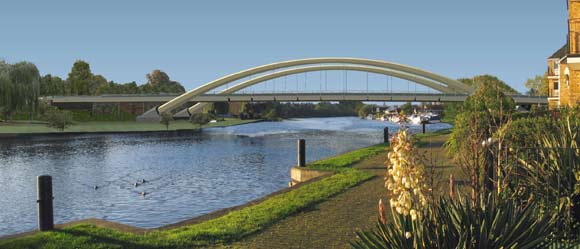
Agreed sixth Walton Bridge. Computer Generated, 2008
2009: The Bridge scheme -

2010 -
Transport secretary Lord Adonis approved the order for the new bridge,
which will join Walton and Shepperton in the summer of 2013
if construction deadlines are met and appropriate funding is acquired.
Lord Adonis approved the order to acquire the land for the Walton Bridge project as well as two further orders,
which will pave the way for its construction following a two-day public inquiry held last summer.
The new structure will replace the current Walton Bridge, which is expected to become structurally weak by 2015.
Work on the £30M project is subject to the successful acquisition of funding from the Government.
Once the money is in place,
officials at Surrey County Council expect work to commence in early 2010 if the 2013 deadline is to be met.
2010, December 29th, Guardian:
The river Thames is to get its first major road crossing in 20 years after the government backed a £32m bridge.
Forming part of the A244, the structure between Walton and Shepperton in Surrey will replace a temporary bridge.
It will open to traffic by summer 2013.
Surrey county council said the scheme was important to relieve pressure on the area's traffic-clogged roads.
Grander attempts to span London's main river have faltered in recent years,
with the £500m Thames Gateway project beset by funding concerns and protests from environmental groups.
Announcing the more modest Shepperton crossing, the local transport minister, Norman Baker, said:
"The new bridge will bring long-term benefits to those travelling in the area.
Without this investment motorists would have faced huge disruption and delays."
Since 31 January 2011 the Council's contractor Costain has been carrying out preparatory works, ready for the start of the main construction works in January 2012.
All the archaeological trenches have now been completed, together with the historic building recording for Walton Bridge House and Toll Cottage.
On 9 September two-way working was re-introduced in Walton Lane, Shepperton between Walton Bridge Road and Thames Meadow. The two-way working is needed so that construction traffic can exit directly onto Walton Bridge Road, and thus avoid using the residential section of Walton Lane. In the interests of road safety there is a ban on the right turn from Walton Lane into Walton Bridge Road, with vehicles being diverted via Marshall's Roundabout.
The landscaping works in the new areas of open space are progressing well, with the majority of the earth moving completed.
Major works are now commencing to relocate the pipes and cables that are in the way of the main construction works. A pipeline that runs the length of Cowey Sale is being moved, and Open Reach have started moving their cables that run parallel to the Cowey Sale viaduct.
Works to establish a temporary site compound at Broadwater Farm are nearly completion, and many members of the project team will move there during October.
Other work to be undertaken this year includes the extension of the Cowey Sale car park; the demolition of the properties on the Shepperton side of the river, (between the existing bridges and Bridge Marine); the provision of temporary toilet facilities, (prior to the existing building being demolished); and the temporary relocation of Cafe Gino.
The existing bridges will be kept open whilst the new bridge is constructed, although there will be the need for a few overnight or weekend closures as the work progresses. These closures will be publicised in advance once the dates are known.

Fifth Walton Bridge, Doug Myers © 2011

Beside Walton Bridge, Doug Myers © 2011


Shepperton Marina
1890: Walton on Thames, Swan Hotel, Francis Frith -

1890: Walton on Thames, Swan Hotel, Francis Frith
1899: Walton on Thames Boathouse, Francis Frith -

1899: Walton on Thames Boathouse, Francis Frith