2010
2011
2012
2013
2014
BOAT RACE 2010s - Oxford University v Cambridge UniversityClick for - LIVE MAP with boats - TIDEWAY TIDES - TIDES FORECAST - RIVER FLOW
Port of London Rowing Chart Richmond Lock to Fulham Rail Bridge
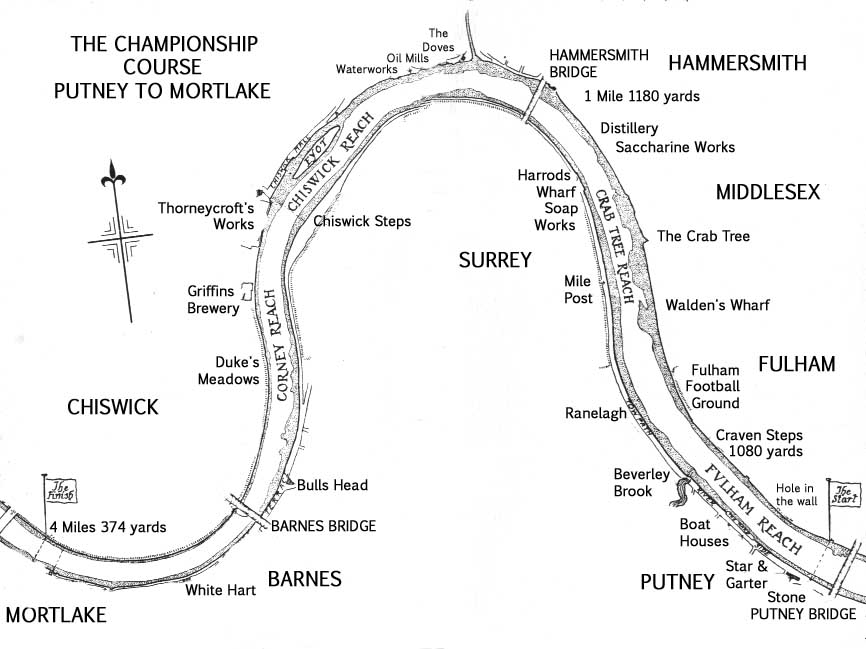
Map taken from George Drinkwater's "The Boat Race"
156: Saturday, 3rd April, 2010 at 1630
Cambridge won the 156th boat race by 1 1/3 lengths in 17 minutes 35 seconds. Oxford 75, Cambridge 80.
[ 2010: RESERVES GOLDIE by 2 lengths 18:03 ]
Oxford won the toss and chose Surrey. Oxford had if anything the best start and looked the better crew.
They slowly eased away from Cambridge, and at the mile post were a third of a length up.
Then Oxford held their lead on the Middlesex bend in favour of Cambridge.
At Hammersmith Bridge the Oxford lead was nearly a length with the long Surrey bend still to go.
At this point few people outside the Cambridge boat would have given much for their chances.
But then they slowly began to go up on Oxford despite being on the outside of the bend.
That was a blend of training and sheer guts to be able to produce that much power at that stage
when it would have been easy to feel they were beaten.
When Oxford should have opened up perhaps a length of clear water
Cambridge actually made up water on them. At Chiswick Steps Cambridge were a canvas down;
but then came out of the bend with their bows ahead
and led by two thirds of a length at Barnes Bridge
From then on the bend was in Cambridge's favour and they eased into a lead - and though Oxford hung on grimly
they never really threatened the Cambridge lead.
Towards the finish Oxford who might have held Cambridge to half a length
appeared to give up the fight and lost by four seconds.
The coxing was superb, particularly Cambridge - and though clashes did appear possible and the courses were rightly aggressive,
clashes were avoided and the umpire struck a good balance, warning without nagging.
Cambridge achieved what is the classic Cambridge rowing move - which is to increase speed, not by raising the rating,
but by raising the power. Since the stroke length is, or should be, more or less fixed, this implies that,
as the time in the water is decreased, so the time on the slide is increased leaving the rating the same.
To do this in the second half of a boatrace is an enormous tribute to their training.
157: Saturday, 26th March, 2011 at 1700
Oxford won the 157th boat race by 4 lengths in 17 mins 32 secs. Oxford 76, Cambridge 80.
[ 2011: RESERVES ISIS by 6 lengths 17:38 Faster than Cambridge ]
A very modest tide and not too much wind.
Oxford won the toss and chose the Surrey station.
Oxford, the lighter crew, appeared keener and more on top of their work from the very start.
In comparison Cambridge seemed powerful but almost lumbering. Oxford led from the start, inching away at first, holding
Cambridge's pushes and then in the middle of the race taking a decided lead which enabled them to choose their water.
From then on at several points Cambridge were on the Surrey station and Oxford nearer Middlesex.
This at the very least suggests disagreement as to where the tide was - but if Oxford erred in coming over too far there
is little to be said because they won decisively.
Cambridge in training appeared to be having a much more pleasant time of it and majored on the fellowship between their oarsmen.
Oxford in contrast were much more coldly scientific and placed relationships lower down their order of priorities.
In terms of the debate raised on this website (see Henley Regatta) this was a victory of the athletes over the gentlemen.
By that I do not mean to imply anything less gentlemanly about Oxford - merely that their attitude to the task in hand was
a colder more rational approach.
The umpire warned both boats significantly in the first few minutes and the coxes seemed to take notice of him.
At one stage there was a significant overlap of oars and disaster was possible.
(ie oars might have clashed, breaking oars or riggers and even injuring rowers)
However as Oxford pulled ahead that problem resolved itself and though the umpire showed signs of nerves obviously
thinking what would happen if Cambridge did in fact manage to come back, they didn't, and that was that.
158: Saturday, 7th April, 2012 at 1415
Cambridge won the 158th boat race. Oxford 76, Cambridge 81. No time was taken and no (lengths) verdict given.
[ 2012: RESERVES ISIS by 5 lengths 16:41 ]
Cambridge won the toss and chose the Surrey station.
Oxford were favourites despite giving away a stone and a half and 2 inches in height.
Oxford made the better start though they were warned several times for coming over towards Cambridge.
Cambridge slowly settled and held them and even caught up a little on the outside of the first bend.
It was turning into a most impressive battle with Cambridge just holding Oxford, with Oxford probably better placed to win -
until 10 minutes and 40 seconds into the race when Matthew Pinsent, assistant umpire, spotted a swimmer in the water
ahead of Oxford. The umpire stopped the race with only a few feet to spare before the swimmer who ducked under
Oxford's strokeside blades.
With both crews easied the following launches had to do emergency stops and created a great deal of wash.
Assuming the swimmer knew what he was doing he was relying on the race being stopped otherwise the following launches
could well have killed him.
Both crews then had to spin and go back below Chiswick Eyot. This all took some time as the following launches had
to turn and pass the crews and reform below them.
On turning again and approaching the restart the Cambridge cox probably decided that the wash was too high
and turned back downstream in order to give the wash time to subside. Oxford followed suit.
The Umpire and the coxes did a magnificent job on restarting the race when eventually the crews returned.
Oxford probably made a better restart but pushed over towards Cambridge and were warned two or three times
before a clash occurred and Oxford six lost the entire blade section of his oar.
Oxford appealed to the umpire to stop the race which he refused to do, so the race continued with Cambridge
naturally taking the lead and opening up to about five lengths at the finish.
The Umpire confirmed that the result stood.
He was asked about his decision and pointed out that the rules say 'a crew must abide by its accidents'.
In other words that damage which occurs to a boat does not affect the result
unless it was caused by the fault of the other crew. Cambridge he decided were in their right position
and Oxford were being warned at the time - so the damage to the Oxford boat was not Cambridge's fault.
The race therefore could continue. The Oxford cox claimed that the wash affected her steering
and prevented her moving away from Cambridge. Only she could tell if that was so.
The wash was certainly still significant at that point.
On the finish the Oxford bow man lay back horizontally in his seat
and eventually after a minute or two it was realised that there was a medical emergency
and he was taken up into a launch and given medical treatment.
Dr Alexander Woods was reported to be sitting up and responding to treatment.
He was taken to Charing Cross Hospital.
We wish him a speedy recovery. Meanwhile the presentation was cancelled.
What a race! It must be recorded as a Cambridge win - but many will sympathise with Oxford.
The umpire and the Cambridge cox did magnificent jobs.
Who knows what the result of a fair race between those two crews would be?
There was too much wash. The Umpire's boat was a relatively low wash catamaran.
The Henley type launches made their usual contribution, but following them were some larger boats with
altogether appalling wash. The time has come to take steps to reduce that wash!
| 2012 AVERAGES: | AGE | WEIGHT | HEIGHT |
| Oxford | 26 | 88.5Kg (13st 13 lbs) | 192cm (6ft 3in) |
| Cambridge | 24 | 96.3Kg (15st 2 lbs) | 195cm (6ft 5in) |
159: Sunday, 31st March, 2013 at 1630
Oxford won the 159th boat race by a length and a third in a time of 17 minutes 28 secs.
Oxford 77, Cambridge 81
[ 2013: RESERVES ISIS by 1/3 lengths 17:51 ]
Oxford won the toss and chose the Surrey station.
Oxford were slightly heavier and had probably better results recently.
At the start Cambridge were ahead for a few feet but the Oxford took a lead which however was not enough for them to cut the first corner
and Cambridge showed a remarkable stamina in holding them.
Indeed this was the whole story of the race. Only towards the end did Oxford achieve clear water
enabling them to prevent Cambridge having the advantage of the final bend.
There were several exciting moments when the blades came within striking distance of each other
as the coxes attempted to take advantage of the bends and force their opponents off the fastest water,
but no contact occurred. Matthew Pinsent umpired the race decisively and fairly.
Altogether it was a relief to see a great race without incident.
The Oxford boat was named Acer in memory of the Oxford cox Acer Nethercott,
who took part in the 2003, 2004 and 2005 boat races and died of brain cancer a few months previously.
| 2013 AVERAGES: | AGE | WEIGHT | HEIGHT |
| Oxford | 25 | 94.7Kg (14st 13lbs) | 194cm (6ft 4in) |
| Cambridge | 25 | 92.1Kg (14st 4lbs) | 195cm (6ft 5in) |
160: Sunday, 6th April, 2014 at 5.55pm
Oxford won the 160th boat race by 11 lengths in a time of 19 minutes 8 secs.
Oxford 78, Cambridge 81
[ 2014: RESERVES ISIS by 13 lengths 18:39 ]
High water at Chelsea at 19:12 bst (18:12 gmt).
Tide almost at Neap level, with a reducing river flow
(now down to 81 cumecs, or about a sixth of what it was at the height of the floods,
and still ten or more times summer levels).
The favourites Oxford won the toss and chose Surrey. They led off the start,
but the less experienced Cambridge crew fought back and took a lead of a few feet.
After five minutes Oxford came back and took half a length.
Cambridge fought hard until Oxford's 7 blade just caught Cambridge's 2 blade and flipped it over,
causing a classic crab which unseated the Cambridge 2 and nearly threw him out of the boat, breaking the rigger.
After this it just became a procession as Cambridge lost their sparkle
and slowly fell behind with 2 unable to contribute much.
Cambridge went through the motions of appealing
but the umpire Richard Phelps explained
I was concerned where Oxford were, so I warned Oxford and they moved immediately.
A second later I was happy where the crews were but I then saw the Cambridge bow just twitch-in towards Oxford,
so I warned Cambridge. The next thing there was a slight contact but the impact was great.
Cambridges view was that when the foul occurred Oxford were not on their station.
From my perspective Oxford were on their proper station; quite clearly.
Contact could only have been in neutral water or at the worst Cambridge were off their station.
I advised Cambridge I was overruling their appeal."
I think it was a coxing incident which can hardly have changed the final result -
Cambridge had already shot their bolt and the more experienced Oxford crew had responded already and were in
a position to take the advantage of the coming bends.
I reckon Oxford would have won by 2 or 3 lengths if that incident had not occurred.
The verdict was 11 lengths.
Bow 2 3 4 5 6 7 Stroke Cox |
OXFORD 2014 Storm Uru Tom Watson Karl Hudspith Tom Swartz Malcolm Howard Michael Di Santo Sam O'Connor Constantine Louloudis Laurence Harvey |
Bow 2 3 4 5 6 7 Stroke Cox |
CAMBRIDGE 2014 Mike Thorp Luke Juckett Ivi Dawkins Steve Dudek Helge Gruetjen Matthew Jackson Joshua Hooper Henry Hoffstot Ian Middleton |
| 2014 AVERAGES: | AGE | WEIGHT | HEIGHT |
| Oxford | 26 | 88.1Kg (13st 12lbs) | 190cm (6ft 3in) |
| Cambridge | 24 | 92.3Kg (14st 7lbs) | 197cm (6ft 6in) |
161: Boat-Races, Saturday, 11th April, 2015
Oxford Men won the 161st Men's boat race by 6 lengths in 17 minutes 35 seconds
Oxford 79, Cambridge 81
Oxford Women won the Women's boat race by 6.5 lengths in 19 minutes 45 seconds.
Cambridge Women lead by 40 to 30 since the first race in 1927
| TOSS | BOAT | RACE | |
|---|---|---|---|
| WOMEN | 15:00 | 16:02 & 16:07 | 16:50 |
| ISIS & GOLDIE | 15:30 | 16:32 & 16:37 | 17:20 |
| MEN | 15:45 | 17:02 & 17:07 | 17:50 |
| London Bridge | Chelsea | Richmond | |
|---|---|---|---|
| Low tide | 12.50 bst | 13:23 bst | 15:16 bst |
| High tide | 19:04 bst | 19:20 bst | 19:59 bst |
Bow 2 3 4 5 6 7 Stroke Cox |
OXFORD MEN 2015 Will Geffen Tom Swartz Henry Goodier James O'Connor Jamie Cook Michael DiSanto Sam O'Connor Constantine Louloudis Will Hakim |
Bow 2 3 4 5 6 7 Stroke Cox |
CAMBRIDGE MEN 2015 Jasper Holst Luke Juckett Joshua Hooper Alexander Leighter William Warr Matthew Jackson Ben Ruble Henry Hoffstot Ian Middleton |
Bow 2 3 4 5 6 7 Stroke Cox |
OXFORD WOMEN 2015 Maxie Scheske Anastasia Chitty Shelley Pearson Lauren Kedar Nadine Graedel Iberg Emily Reynolds Maddy Badcott Caryn Davies Jennifer Ehr |
Bow 2 3 4 5 6 7 Stroke Cox |
CAMBRIDGE WOMEN 2015 Hannah Evans Ashton Brown Caroline Reid Claire Watkins Melissa Wilson Holly Hill Daphne Martschenko Fanny Belais Rosemary Ostfield |
Historic moment - the Women's Boat Race held on the same course and on the same day as the Men's race.
In 1866 PUNCH produced this cartoon -

Boat-Race of the Future - Drifting Down to the Start-Point
On Wednesday 1st April 2015 the Oxford Women's Eight sank in rough water at Putney and were
returned to their boathouse by lifeboat. All were reported well and the boat was also recovered.
Wind against tide produced three large waves which just swamped the boat.
Cambridge won the toss and chose Surrey.
Oxford had the better start and Cambridge never quite got onto terms with them.
Halfway through the race a determined Oxford spurted and left Cambridge behind.
The umpire was very active in warning both boats
It never seemed to me that the Cambridge boat was running in the way the Oxford boat achieved.
Was it my imagination or was the wake slightly more turbulent? Could they have been too heavy for their boat?
BOAT RACE RESULTS - WOMEN -
 
|
WOMEN, LEAD IN CUMULATIVE WINS: Oxford dark blue, Cambridge light blue
Cambridge Women lead by 40 to 30 since the first race in 1927
BOAT RACE RESULTS - MEN -
After the 2015 race, after one hundred and sixty one boat races, the overall tally is:
Oxford Men 79, Cambridge Men 81 (and one dead heat)
The lead in the Overall Tally of Men's Boat Race Wins has only changed hands three times in all those years.
Scores were equal in 1836, 1863 and 1929.
Oxford Men won the 1829 first race.
Cambridge Men led from 1839 to 1862.
Oxford Men led from 1864 to 1928.
Cambridge Men led from 1930 to today.
|
|
|
1829 - - - - - 1863 - - - - - - - - - - - - - - - - - - - - - - - - 1929 - - - - - - - - - - - - - - - - - - - - - - - - - - - - - - - - 2015 MEN, LEAD IN CUMULATIVE WINS: Oxford dark blue, Cambridge light blue |
IN TWO OUT OF EVERY THREE MEN'S BOATRACES THE WINNER IS LAST YEAR'S WINNER!
THE HEAVIER CREW HAS WON 8 OUT OF THE LAST 12 BOAT RACES
2015 figures
Considering the race as one continuous whole 1829 - 2015 the men's crews have covered about 689.5 miles.
Assuming 1 length = 3 seconds and 'Easily' to mean 10 lengths, 30 seconds,
and excluding races in which less than two crews finished,
In about 53 hours and 5 minutes racing
CAMBRIDGE MEN LEAD by 4 minutes and 49 seconds, about 97 lengths,
(which is about 1.8 seconds, 0.6 of a length per race)
|
|
|
1829 - 1863 - - - - - - - - - - - 1929 - - - - - - - - - - - - - - 2015 MEN: LEAD IN LENGTHS OVER ALL 681 miles |
And the moral is - well logically there are four possibilities -
WHEN CAMBRIDGE WIN THEY WIN BY MORE! (which is the same thing as)
WHEN OXFORD LOSE THEY LOSE BY MORE!
WHEN OXFORD WIN THEY WIN BY LESS!
WHEN CAMBRIDGE LOSE THEY LOSE BY LESS!
Actually the issue is what you do when you are being beaten - do you give up and save your efforts for another day -
or do you persevere regardless?
This is ultimately part of the "Athletes v Gentleman" debate which this site looks at on the Henley Regatta page.
The athletes will tend towards a realistic acceptance of an impending result whilst the "Gentlemen" will see it in terms
of "guts" and aggression. (In this, as in much else, the whole world is biased, except me.)
I declare my wish to state the above idea in a non-gender specific way - but every time I try it looks pathetic!
Actually the Women athletes need to formulate where they stand in this issue -
"guts" and "aggression" are clearly different for them
and no doubt they would not wish simply to copy the male stereotype?
Check my Spreadsheet - and tell me any errors!
|
|
|
1829 - 1863 - - - - - - - - - - - 1929 - - - - - - - - - - - - - - 2015 LEAD IN EACH SEPARATE RACE: Oxford dark blue, Cambridge light blue |
Throughout the boat race reports there is some question as to the relationship between lengths and time interval.
Before 1977 the assumption was 3½ seconds = 1 length.
The usual assumption since 1977 is 3 seconds = 1 length; this is about right for an 18 minute race speed.
Given a standard length boat of 62 feet and assuming that the finishing speed is the average speed over the race:-
A 17 minute speed would be 1.05 lengths in 3 seconds; 1 second = 0.35 length; 10 seconds = 3½ lengths
An 18 minute speed would be 0.99 lengths in 3 seconds; 1 second = 0.33 length; 10 seconds = 3.3 lengths
A 19 minute speed would be 0.95 lengths in 3 seconds; 1 second = 0.32 length; 10 seconds = 3¼ lengths
And a 20 minute speed would be 0.9 lengths in 3 seconds; 1 second = 0.3 length; 10 seconds = 3 lengths.
Click for Hammersmith Bridge
The first boat races (pre 1850)